Australia Beekeeping Laws: Biosecurity & Registration
By UrbanBee Editorial TeamSources checked Oct 14, 2026
⚠️ Not Legal Advice: Summaries for educational purposes only. Verify with official Australia authorities.
Australian honey bee keeping is regulated mainly through state and territory registration, biosecurity duties and local property rules. The national bee biosecurity code provides a common framework, but it is not one uniform licence, fee schedule or backyard setback law.
Choose the state where the hives will be kept, register with its responsible authority and check the council’s requirements for the actual address. Before moving bees, also check the destination’s current pest and movement controls.
Compare three state registration systems
| Requirement | New South Wales | Victoria | Queensland |
|---|---|---|---|
| Honey bee registration | Required through DPIRD | Required through Agriculture Victoria/BeeMAX | Required as a biosecurity entity from 1 European honey bee hive |
| Registration period | 2 years | 2 years | Use the entity registration and renewal instructions |
| Fees checked October 2026 | Depends on registration class and filing method | Fees waived from 1 October 2025 for 2 years | Non-commercial registration free; commercial charges apply |
| Hive identification | Follow NSW registration and labelling rules | Follow Victorian branding requirements | HIN; state-specific marking rule |
| Local limits and setbacks | Council and site dependent | Apiary Code and local planning apply | Council and site dependent |
Start with NSW state apiary registration rules, Victoria Agriculture beekeeping laws or our Queensland registration and Brisbane guide. These examples do not describe Western Australia, South Australia, Tasmania, the ACT or the Northern Territory.
Guides for all eight states and territories
| Jurisdiction | Detailed registration and biosecurity guide | City follow-up |
|---|---|---|
| New South Wales | NSW state requirements | Sydney council and property checks |
| Victoria | Victorian registration and Apiary Code | Melbourne courtyards and roofs |
| Queensland | Queensland registration and hive identification | Brisbane current-law review |
| Western Australia | WA registration, branding and records | Check the governing council |
| South Australia | PIRSA registration and renewal duties | Check the governing council |
| Tasmania | BeeTAS registration and entry conditions | Check the governing council |
| Australian Capital Territory | ACT and Canberra hive requirements | Canberra is covered in the same guide |
| Northern Territory | NT registration, training and movement rules | Check the governing council |
What the National Biosecurity Code covers
The Australian Honey Bee Industry Biosecurity Code of Practice addresses registration, inspections, pest and disease control, records, hive maintenance and training. Its current publication includes changes responding to established Varroa in some states.
Separate the national standard from its legal implementation. A state may adopt provisions through legislation or registration conditions, alter a particular requirement or treat part of the code as a recommendation. NSW, for example, publishes conditions for all beekeepers and additional duties for those managing 20 or more hives.
Read the current code alongside your registration certificate. A summary based on an older edition can miss changed reporting thresholds or state-specific exceptions.
Inspections and Varroa management
The BeeAware inspection guidance describes routine visual brood inspections and testing for arthropod pests. Its baseline includes at least two annual visual inspection rounds, separated by at least four calendar months, with more frequent work when needed to control disease.
That minimum is not a practical ceiling for colony inspections or Varroa monitoring. Check your state’s current instructions for test method, sampling, frequency, first detections and treatment records. A rule from an old eradication-zone notice may no longer describe the current management system.
Where an applicable order or registration condition requires it, our guide to performing mandatory alcohol wash checks helps explain the technique. Alcohol washing kills the sampled bees; locate and exclude the queen. Do not infer that alcohol washing, rather than another accepted method, is universally compulsory across Australia.
Hive identification numbers and brands vary
Use the code allocated to your registration and follow your state’s placement, size and legibility instructions. There is no single national rule requiring a 25 mm HIN on every brood box.
For example, Queensland’s branding page requires at least one hive in every 50 to bear the HIN and recommends marking every hive. Its front-of-hive mark must use block letters at least 25 mm high. Other states use their own rules.
A brand identifies ownership and supports tracing. It does not prove that the hive is healthy, inspected or permitted at the property.
Records: retain the longer applicable period
The national code’s record framework covers inspections, tests, treatments, hive movements, introduced bees and equipment, and biosecurity training. The published code specifies a minimum three-year retention period.
Some state duties are longer. NSW requires specified loss, disposal and transfer records for five years. Keep the records for the longest applicable period and maintain enough detail to trace a colony or equipment transfer.
Record dates, apiary locations, hive identities, sample results, treatments and supplier information while the work is fresh. Separate medical-treatment directions from legal reporting duties, and use only products and methods authorized for the intended use.
Local permission and interstate moves
Check zoning, permitted hive numbers, water, flight paths and nuisance provisions with the council. Public land and forest apiaries may need a separate site permit. A property owner’s consent also matters when you keep bees on borrowed or rented land.
Before crossing a state boundary, verify both origin and destination requirements for live bees, queens, used boxes, comb and relevant bee products. Keep the movement documents with the shipment and the apiary record.
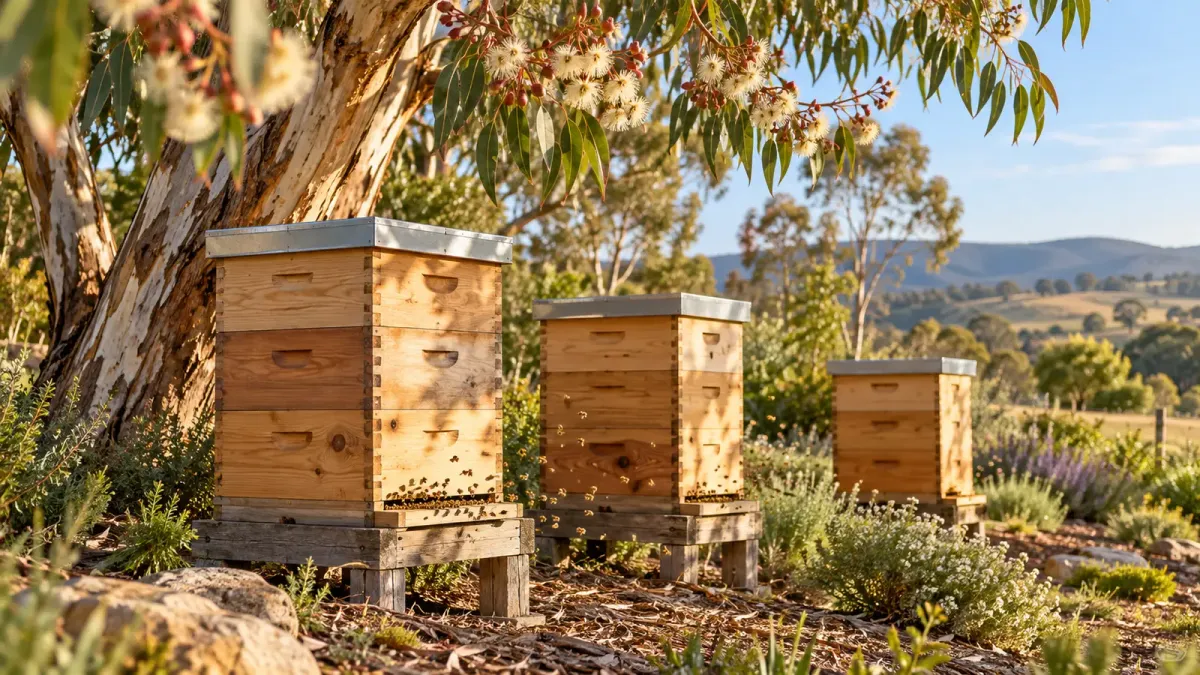
The hero is an AI-generated illustrative scene. It is not a legal hive-brand template or a photograph of an approved apiary.
Frequently asked questions
Do you need a licence to keep bees in Australia?
European honey bee keepers generally need state or territory registration, with local council and land-use requirements checked separately. There is no single national backyard beekeeping licence that approves every property.
Is a Hive Identification Number the same in every state?
No. Registration codes, branding terminology, marking rules and administrative systems vary. Queensland uses a HIN; follow the rules issued by the state or territory responsible for your hives.
Is the national bee biosecurity code law everywhere?
The code provides national biosecurity standards, but enforceable requirements depend on state legislation, registration conditions and the applicable version. Check which provisions your authority has adopted.
Can I move registered hives freely between Australian states?
No. Destination requirements, movement controls, permits, declarations and pest status can differ. Check both jurisdictions immediately before moving bees, products or used equipment.