ACT Beekeeping Laws: Canberra Registration & Hive Rules
By UrbanBee Editorial TeamSources checked Oct 14, 2026
⚠️ Not Legal Advice: Summaries for educational purposes only. Verify with official Australian Capital Territory (Canberra) authorities.
Canberra beekeeping requires registration under the ACT Biosecurity Regulation 2025, including for hobby honey-bee keepers. Registration is free and lasts three years; equipment and disease-prevention rules also apply.
Register before installing colonies, read the current rules and confirm permission for the property. A nearby New South Wales registration should not be treated as an automatic ACT exemption.
ACT and Canberra requirements compared
| Issue | Current ACT position | Next step |
|---|---|---|
| Registration | Compulsory for commercial and non-commercial keepers | Use the official online form |
| Fee and term | Free; three years | Retain confirmation and renewal date |
| Interstate registration | Conditional exemption under section 24 | Ask ACT Biosecurity to assess the details |
| Hive format | Honey bees must be kept in frame hives | Check inspectability before buying |
| Honey feeding | Prohibited | Use a lawful feeding method when necessary |
| Site use | Separate property and land-use questions | Obtain the responsible authority’s permission |
The City Services bee guidance explains these requirements and links the regulation. The ACT permits and registrations page provides the wider biosecurity process.
Confirm any interstate exemption in advance
Canberra’s proximity to NSW makes cross-border movement easy, but the legal registration question still needs checking. Provide ACT Biosecurity with your name, contact details, interstate jurisdiction and registration number.
Ask what evidence demonstrates the section 24 conditions for your operation. Retain the response with the registration and movement records rather than relying on an informal assumption that two systems are interchangeable.
For a site across the border, use the New South Wales guide. The location where the colony physically sits determines which site requirements need review.
Use frame hives and avoid exposed honey
The ACT framework prohibits keeping honey bees in a unit other than a frame hive. It also prohibits feeding honey and exposing honey or comb outside a frame hive in a way accessible to other honey bees.
When extracting, close up equipment and manage spills promptly. Keep discarded comb and stored boxes inaccessible to visiting bees. A small amount left out as a “treat” can undermine disease prevention.
Plan inspections around equipment that allows proper brood examination. Our foulbrood comparison guide helps identify suspicious signs, but suspected notifiable matters require contact with ACT Biosecurity.
Permission for a garden, roof or community site
Identify the property manager and any applicable planning conditions. On a shared garden, agree on the precise enclosure, inspection access, backup keeper and removal process.
The ACT’s guidance encourages the Australian Honey Bee Industry Biosecurity Code of Practice. Distinguish that management guidance from the specific prohibitions and reporting duties in the legal framework.
Provide water and position entrances away from routinely occupied paths. Our flyway barrier guide can help organize flight routes; a screen does not establish land-use permission.
Know which service handles a problem
City Services provides a reporting process for nuisance hives on ACT Government land and directs private-property swarm inquiries to collectors. Biosecurity concerns belong with the ACT bee-health authority, using the current official contacts.
Keep registration, property permission, movement records and inspection notes in one file. The Australian framework guide and international research hub provide the broader context.
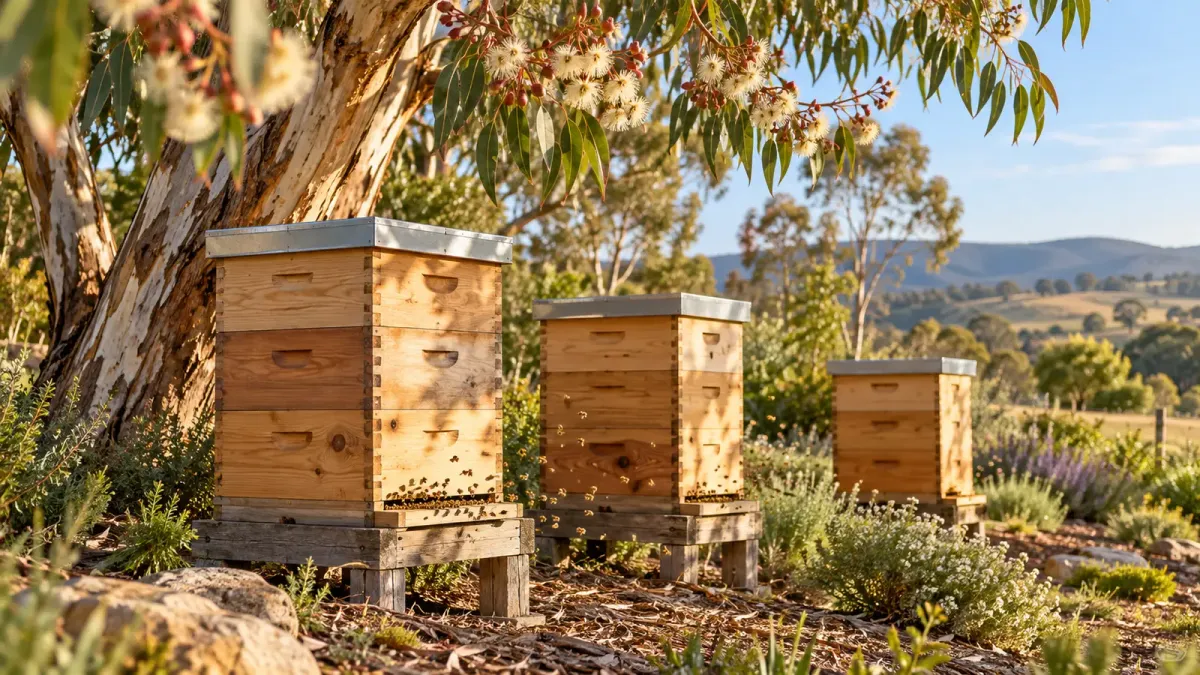
The hero image is an AI-generated illustration; it does not document an approved apiary or measured legal distances.
Frequently asked questions
Do I need to register a backyard hive in Canberra?
Yes. ACT guidance requires commercial and non-commercial honey-bee keepers to register under the Biosecurity Regulation 2025. Registration is free and lasts three years.
Does NSW registration automatically exempt me in the ACT?
No automatic exemption should be assumed. A corresponding interstate registration may qualify only if the requirements of section 24 are met; ask ACT Biosecurity to confirm your case.
Can I feed honey to bees in the ACT?
ACT guidance says the Biosecurity Regulation 2025 prohibits feeding honey to honey bees. It also prohibits accessible exposure of honey or honeycomb outside a frame hive.
Does an ACT registration approve a shared garden hive?
No. Confirm the site’s land-use and property conditions and obtain permission from the responsible owner or manager. Registration addresses biosecurity rather than ownership or access.