NSW Beekeeping Regulations: Registration & Varroa
By UrbanBee Editorial TeamSources checked Oct 14, 2026
⚠️ Not Legal Advice: Summaries for educational purposes only. Verify with official New South Wales authorities.
NSW beekeeping regulations require owners of European honey bees to register with the Department of Primary Industries and Regional Development (DPIRD) and comply with registration and biosecurity conditions. Registration lasts two years; council and property permission still need a separate check.
Apply through the state’s online portal and confirm the hive location with your local council before acquiring bees. For Varroa, use current DPIRD guidance rather than assuming that an older eradication-zone map or 16-week emergency schedule still applies.
NSW requirements and registration fees
| Topic | Requirement or current amount | Practical action |
|---|---|---|
| Registration | Required; valid for 2 years | Apply through the Biosecurity and Food Safety portal |
| Online fee | AUD 90 business; AUD 54 recreational; AUD 36 concession | Choose the correct class |
| Paper fee | AUD 100 business; AUD 60 recreational; AUD 40 concession | Confirm current tariff before filing |
| Local permits and hive count | Depend on council, planning and property conditions | Submit a specific address and site plan |
| Boundary placement | No statewide suburban distance verified here | Meet nuisance duties and applicable local conditions |
| Records | Specified loss, disposal and transfer records kept for 5 years | Save dated, traceable records |
Fees are those displayed by DPIRD when checked on October 14, 2026. They are registration charges, not the total cost of local approvals or maintaining an apiary.
Register and maintain the certificate
Service NSW links to the application portal and explains the information required. The registration class depends on the intended activity; a business class is not simply a label for a large hive count.
Keep your certificate and current conditions accessible. Update locations and hive numbers through the approved process, and follow the seven-day contact-change notification duty described on the DPIRD registration page.
Read the Australian National Biosecurity Code of Practice overview together with the NSW conditions. Some national provisions are modified locally, and additional compliance duties apply when managing 20 or more hives.
Varroa reporting and monitoring now
The current NSW Varroa page says beekeepers must report their first Varroa detection. Those who have already notified the department do not need to report its presence again. Other notifiable pests and diseases have their own duties.
Regular monitoring remains necessary after a first report. Keep the test date, method, colony identity, mite result and treatment response together. Ask a Bee Biosecurity Officer about uncertainty over the applicable schedule or current movement conditions.
DPIRD has also reported treatment resistance in NSW. A low or disappointing response should prompt a review of the approved management plan and product directions, not an improvised dose. Rotate modes of action where appropriate and check treatment effectiveness as instructed.
Do not describe all of NSW as subject to the original 2022 red, purple or blue zone arrangements. Check current legal notices before moving bees, products or used equipment, especially across a state boundary.
Sydney council rules: verify the actual suburb
Sydney includes multiple local government areas. A City of Sydney policy, a neighboring council’s animal law or an association’s recommended hive count may not control the intended property.
Ask the responsible council about the land use, colony number, proposed location, fences and any building work. The sources reviewed do not establish a universal two-hive allowance on every block below 600 square metres or a statewide three-metre fence exemption.
For installing flight screens for suburban yards, plan the departure route around footpaths, doors, shared areas and the neighbor’s garden. A screen can improve that route but cannot override a council condition or an unsuitable site.
Hive health, water and record keeping
Use equipment that meets NSW’s movable-frame requirements and current labelling rules. Keep a stable water source available, avoid exposing honey or comb to robbing, and make arrangements for swarm control and absences.
When selling, giving away or disposing of colonies or queens, retain the required recipient and registration details. The five-year NSW record rule for specified transactions is longer than the national code’s baseline record period.
If a neighbor reports a problem, document it and review the relevant entrance traffic, water source and behavior with experienced help. State biosecurity duties include minimizing nuisance or threats to others’ amenity and health.
Finish the registration and site review before installation, and recheck current notices immediately before a move.
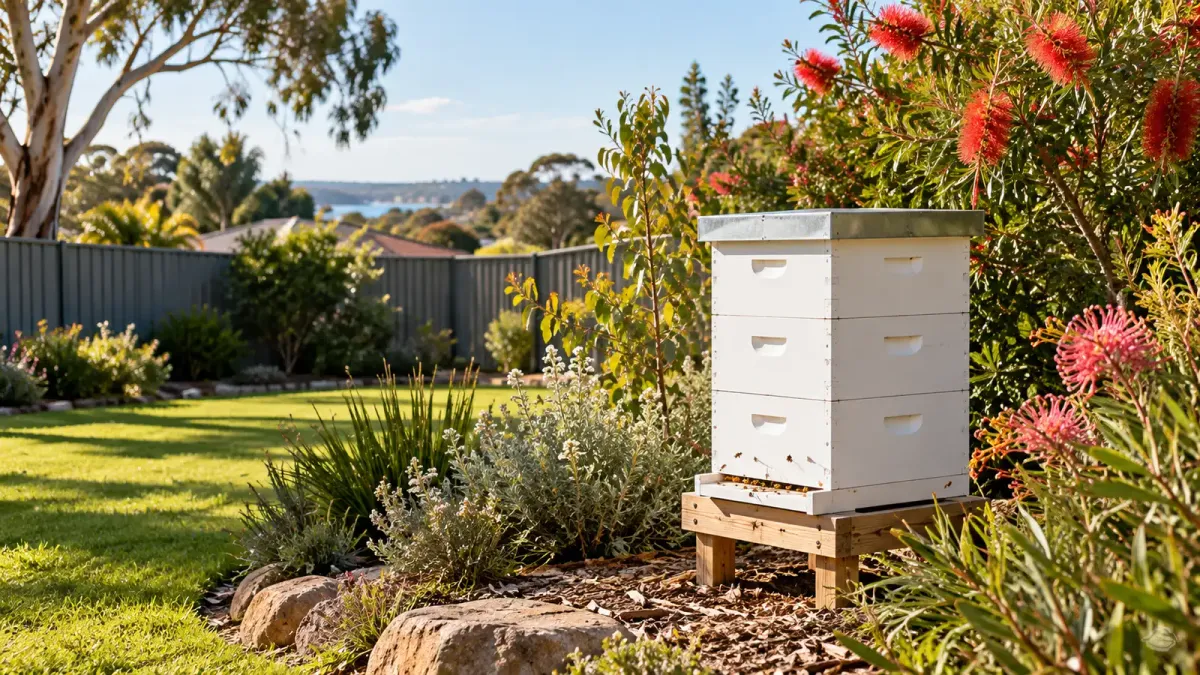
The hero is an AI-generated Sydney garden illustration, not a setback or registration-compliance example.
City of Sydney property and council checks
The Sydney local-site guide explains the City of Sydney boundary, community-garden agreements, strata and roof permissions, and the distinction between a swarm-response service and installation approval.
Frequently asked questions
Do I need to register one honey bee hive in NSW?
Yes. NSW requires European honey bee owners to register with DPIRD. Registration is valid for two years and the fee depends on class and filing method.
What is the NSW recreational registration fee?
The page checked in October 2026 lists AUD 54 online or AUD 60 on paper for the two-year recreational class. Business and concession fees differ; confirm the current tariff when applying.
Do I have to report every NSW Varroa-positive test?
The current DPIRD page requires the first Varroa detection in your hives to be reported. It says a beekeeper who has already notified the department does not need to notify the presence again. Keep monitoring and management records.
Can every Sydney backyard have two beehives?
No uniform two-hive allowance for every Sydney address was verified. Check the relevant council, planning controls, property restrictions and NSW nuisance duties for the proposed location.