How to Stop Bees Swarming Your House or Yard
The best way to discourage honey bees from nesting in your house is to close access to suitable, unoccupied cavities—not spray the yard with a repellent. Repair damaged siding and appropriate vent screens before bees arrive. If bees already travel through one opening repeatedly, stop: have the cavity assessed before sealing anything.
For a cluster hanging on a branch or fence, keep children and pets away and contact a local swarm collector if the location creates a problem. Take a photograph from a safe distance and describe the height, access, and any entry into the building. Our guide to what to do when a bee swarm lands in your yard covers that immediate situation.
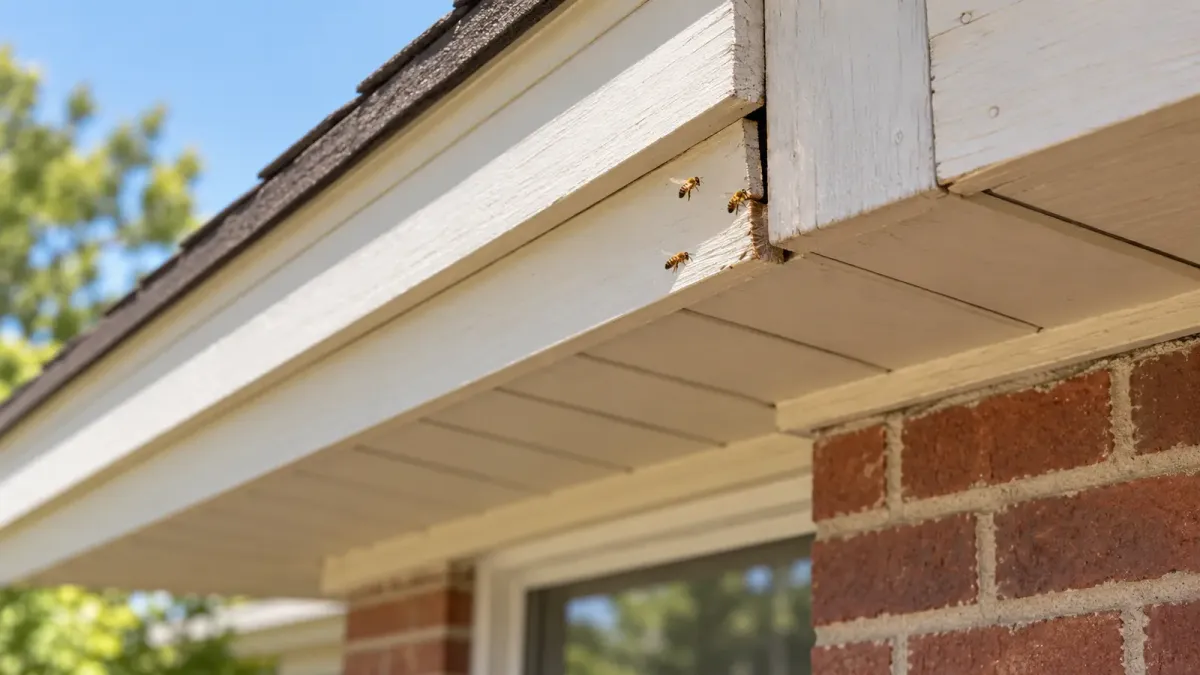
The AI-generated hero illustrates bees near an eave gap. A photograph like this cannot establish whether bees are scouting or already living inside.
Scout Bees, a Swarm, or a Colony in the Wall?
| What you notice | What it might mean | Useful next step |
|---|---|---|
| Individual bees visiting flowers | Ordinary foraging | Leave the flowers alone; look separately for building-entry activity |
| A few bees repeatedly inspecting a crevice | Possible scouting, or activity at an existing nest | Record the location and ask for identification before working on the opening |
| A dense exposed cluster | A temporary swarm cluster, unless comb is established | Keep a clear boundary and discuss collection or observation with a beekeeper |
| Regular traffic into a wall, soffit, or chimney | Bees may be occupying a cavity | Arrange a building-colony assessment; do not seal the entrance |
| Visible wax comb supporting bees | An established nest rather than simply a resting cluster | Seek a specialist with suitable access equipment |
Mississippi State Extension distinguishes temporary swarms from colonies living on comb. You do not need to open the structure to make a useful report. “Bees enter the upper-left soffit joint every few seconds” gives a specialist more to work with than “the house is swarming.”
Why Scout Bees Investigate Houses
Scouts search for a protected place where a colony can build comb. A roof void, hollow column, or wall cavity may offer shelter, and an old nest site can remain attractive after the previous colony is gone. UC IPM describes how scouts select cavities and why old nest odors matter.
There is no dependable homeowner countdown from the first scout to a move-in. Nor can you infer colony size by counting the insects visible at one moment. Act on the access problem while it can still be assessed safely.
How to Bee-Proof Unoccupied Gaps Before Swarm Season
Walk around the exterior from ground level. Note damaged soffits, gaps around non-electrical service penetrations, loose siding, and openings in hollow porch details. Check sheds and stored containers too.
For each location, separate a defect from an opening the building needs:
- Unintended gaps: Ask for a durable repair compatible with the siding, flashing, or sealant system.
- Ventilation openings: Replace damaged exclusion screens without restricting required airflow.
- Masonry weep holes: Preserve drainage. Ask a building professional whether a purpose-made insert is appropriate; do not stuff or caulk them shut.
- Chimneys and appliance exhausts: Use a qualified chimney or mechanical professional to select any approved cap or guard.
- Electrical equipment: Leave service heads, meter equipment, and power-line penetrations to the utility or a qualified electrician.
These are different repair jobs. A material suitable for an ordinary siding gap is not automatically suitable for a hot flue or a drain. Do not install improvised mesh over dryer exhausts or combustion-air openings.
UGA Extension recommends closing potential bee-entry gaps and screening openings where ventilation is necessary. That advice belongs in a maintenance plan for unoccupied spaces, not an emergency attempt to trap an active colony.
Safety alert: Do not climb toward bees, use smoke or fire at an eave, or work near electrical service lines. If several stinging insects attack, get indoors; do not jump into water. Severe allergic reactions require emergency care. See CDC’s precautions for stinging insects.
Do Natural Bee Repellents or Swarm Traps Work?
Peppermint, citronella, almond scents, and smoke are not a reliable substitute for closing access to a building cavity. A smell disappearing is not the same as a nest site disappearing. Do not pour essential oils into wall gaps or spray a cluster to test a remedy.
A bait hive is also a different tool: it is intended to attract a swarm for managed collection. It cannot guarantee that bees will choose the box instead of your roof. A resident who does not want to manage bees should not add an unattended bait hive beside the house.
Keep unused beekeeping equipment inaccessible to visiting bees, especially comb and boxes carrying old nest material. Ask an experienced beekeeper how to store or remove it rather than leaving it exposed as an accidental lure.
If Bees Are Already Inside, Change the Plan
Repeated entry into a wall calls for assessment, not stronger repellent. Follow how to remove bees if they enter your walls and ask whether the work includes locating the colony, removing comb, cleaning the cavity, and repairing access points.
Before accepting a quote, compare the costs of professional swarm removal with structural removal. A reachable cluster and a colony behind brickwork involve very different work. Free collection is not a promise, and swarm-catching experience alone does not establish building-repair expertise.
Legal alert: Get the owner’s authorization before opening or altering a structure, and check local licensing requirements for the proposed work. Georgia, for example, distinguishes licensed structural honey-bee removal from collection of free-hanging swarms. The Georgia Department of Agriculture explains those categories; other jurisdictions may differ.
After removal, photograph completed repairs and keep the contractor’s follow-up instructions. Check adjacent gaps as well as the former entrance. Prevention is an ongoing maintenance task, not a guarantee that another swarm will never pass through the yard.
What to Tell a Swarm Collector or Removal Company
Make the first call useful without approaching the bees. Have these details ready:
- Location: Your address, the side of the building, and whether access crosses someone else’s property.
- First sighting: When you noticed the bees and whether the activity has changed since then.
- Appearance: A photograph taken with zoom, showing both the bees and enough surroundings to judge access.
- Height and obstacles: Estimate from the ground; mention power lines, a steep roof, locked gates, or a narrow passage.
- Entry behavior: Whether the bees remain in a visible cluster or repeatedly disappear into a gap.
- People affected: Whether the site blocks an entrance or is near children, pets, or someone with a known sting allergy.
- Treatment history: Any spray, oil, smoke, sealant, or previous removal work at the location.
Ask whether the person handles exposed clusters, structural colonies, or both. For work inside a building, confirm who is responsible for opening the structure, removing comb, making repairs, and checking the result. Request a written scope so that “bee removal” does not leave the repair work undefined.
Check the Repair, Not Just the Absence of Bees
After the specialist confirms removal is complete, keep a simple record of the entrance, repairs, and agreed follow-up. Photograph the repaired area from a safe position. If activity returns, report the exact opening rather than adding more sealant over it.
Revisit the exterior after storm damage, siding work, or other changes that may create gaps. Schedule a ground-level check before the locally expected swarm season; your county extension office or beekeeping association can help with regional timing.
Bees on garden flowers are not evidence that the repair failed. Focus on repeated access to the building. If you are unsure what insect you are seeing, use our bee, wasp, and hornet identification guide before requesting a treatment.
Frequently Asked Questions
How do I stop bees from moving into my house?
Have unused entry gaps repaired before bees occupy them, maintain appropriate vent screens, and remove accessible empty nesting containers. If bees already enter a gap repeatedly, arrange an assessment before sealing it.
Will peppermint oil or citronella keep a swarm away?
Do not rely on household scent sprays to protect a building from a honey bee colony. Repairing access to unoccupied cavities is a more dependable prevention strategy than repeatedly applying a smell.
Should I seal a hole when I see bees entering it?
No. Repeated entry may indicate an occupied cavity. Sealing it can trap bees and send them searching for another exit, including indoors. Contact a qualified removal professional.
Will a swarm in my yard leave by itself?
A temporary cluster may leave on its own, but there is no guaranteed deadline or destination. Keep people and pets away and seek collection help if access, vulnerable occupants, or nearby building cavities make waiting unsuitable.