Apartment Balcony Beekeeping: Complete Setup Guide
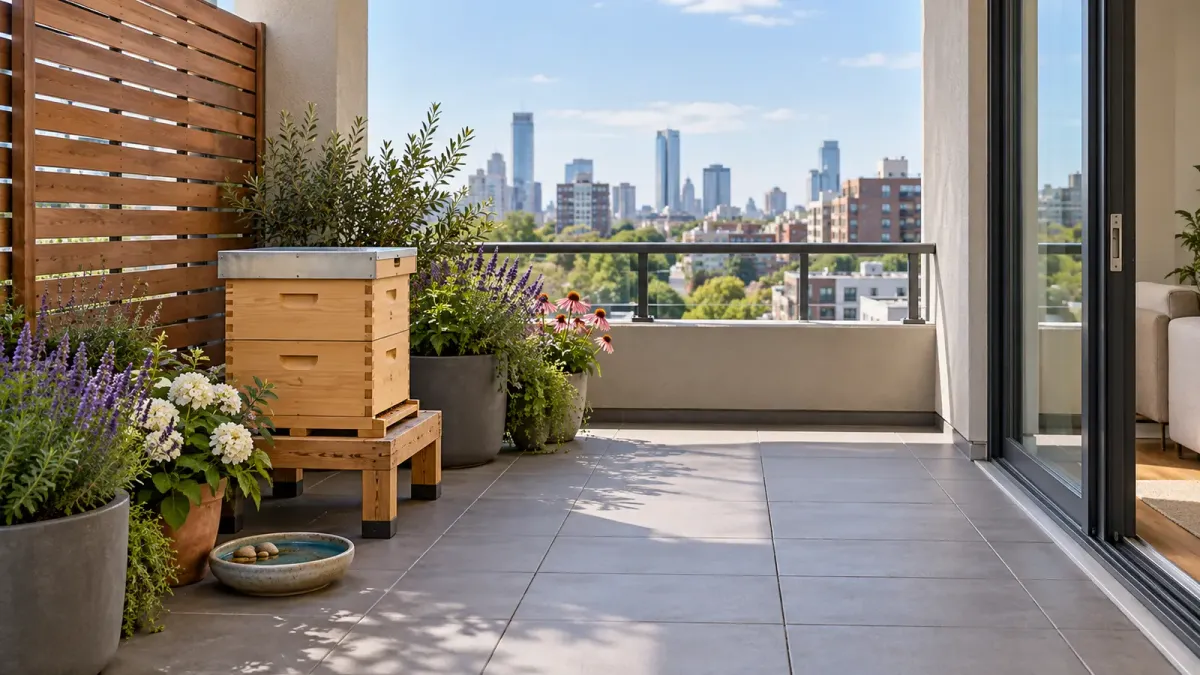
An apartment balcony is a possible hive site only after permission, structural capacity, and safe working access have been confirmed. Do not buy bees because a hive box fits into a corner. A colony needs room for inspections, dependable water, and a flight path that does not make adjacent homes or shared routes unusable.
Start with a measured sketch and a discussion with the property owner, a qualified building professional, and an experienced local beekeeper. If the site fails one of those checks, choose a host yard or community apiary. Use the complete balcony beekeeping foundation guide for the initial suitability decision; this article turns a potentially suitable site into an installation and operating plan.
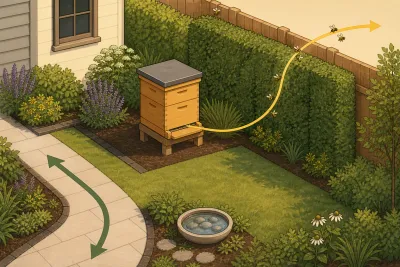
The AI-generated hero is a layout illustration, not a structural design or proof of legal approval. It depicts a spacious recessed terrace; it should not be copied onto a narrow projecting balcony.
Five Checks Before You Order Equipment
| Check | Evidence you need | Stop or change the location if… |
|---|---|---|
| Permission | Local-rule check plus written owner/association approval | A restriction applies or permission remains unclear |
| Structure | Assessment of the specific loading and mounting proposal | Capacity or condition is uncertain |
| Flight path | Review of neighboring windows, terraces, and public routes | Bees would repeatedly cross places people cannot avoid |
| Weather exposure | Plan for wind, reflected heat, drainage, and secured equipment | Making the site usable would require unsafe or unapproved alterations |
| Access | A rehearsed route for inspections, harvest, and relocation | You would block egress, climb a rail, or carry an open colony through occupied space |
Keep a small project folder with the drawing, approvals, professional advice, equipment dimensions, and emergency contacts. That is more useful during a building inspection than a photograph of someone else’s balcony hive.
Legal alert: City permission and property permission are separate. Check the lease, condominium rules, insurer requirements, and any bee-registration obligation. For example, NYC Health requires hive registration and nuisance prevention; those are NYC rules, not a nationwide template.
Balcony Hive Weight: Build a Load Inventory
List the maximum planned hive configuration, including honey-filled boxes, stand, cover, feeders, water, and equipment temporarily removed during inspections. Add the people who will work there and any planters or furniture remaining in the same area.
Do not divide that weight by the balcony’s entire floor area and call the result safe. A hive stand applies load through particular feet, and the building’s condition and support arrangement matter. Let a qualified structural professional determine the relevant load cases and acceptable locations.
Give the reviewer these details:
- Stand footprint and contact points.
- Maximum planned stack of hive boxes.
- Where removed supers will sit during work.
- Water-container capacity and planter locations.
- Proposed screen dimensions and fixings.
- Delivery and removal route.
NYC Buildings’ deck guidance illustrates why added loads and construction details require attention. Its published figures are not a capacity certificate for an existing apartment balcony, in NYC or elsewhere.
Rehearse the Layout With Empty Boxes
Use empty equipment to test whether you can open the lid, lift a frame, set down a box, and reach the door without twisting against the rail. A site can pass a measurement check and still be awkward to work.
Keep the entrance away from the working side. Leave doors, drains, fire escapes, and utility access clear. Do not hang equipment from a guardrail or drill into the facade or waterproofing without an approved design.
UC ANR’s apiary-location guidance emphasizes shelter from strong winds and avoiding flight paths across sensitive areas. Apply those principles to the actual surroundings, including the units above and beside yours—not only the pavement far below.
Balcony Hive Screens, Wind, and Flight Paths
A solid panel, lattice, or planted screen can influence bee traffic differently. None creates an invisible wall around the colony.
| Screen option | Practical consideration | Approval question |
|---|---|---|
| Solid panel | Blocks a direct departure route but receives wind load | Can the proposed support and fixing system be used here? |
| Reed or bamboo screen | Offers partial screening; condition can deteriorate | Is the material and attachment permitted on this building? |
| Lattice with planting | Coverage changes as plants grow or lose leaves | Are planter loads, drainage, and maintenance accounted for? |
Look for overhead obstructions that could deflect departing bees toward neighboring windows. There is no universal floor number at which wind becomes a problem or a screen guarantees a safe ten-foot flight height. Read how to construct small space flyway barriers with the building reviewer before selecting materials.
Put Water and Housekeeping in Place First
Provide a stable, serviceable water source with landing surfaces before bees arrive. Keep it replenished and clean, and prevent overflow onto lower balconies. Oregon State’s residential guidance explains why letting an established water source run dry can send bees elsewhere.
A water dish reduces one reason for visits to neighbors; it cannot guarantee bees will ignore their pools or pet bowls. Assign someone to refill it when you are away.
Keep syrup, honey, and exposed comb out of shared spaces. Use closed storage and a cleanup kit so an inspection does not leave sticky tools or wax scraps on a communal route.
Agree on an Inspection and Transport Routine
Pick suitable weather and a time that limits disturbance to nearby residents. Midday may help when foragers are out, but a neighbor using the next balcony or a strong crosswind can make that a poor moment. Coordinate without promising a sting-free inspection.
Before opening the hive, prepare the frame-resting area, tools, protective equipment, and route back indoors. If smoke cannot be used lawfully and without affecting residents or alarms, discuss site suitability with the owner and mentor; do not simply improvise a different method.
Safety alert: Never block a fire escape, lean over a guardrail to retrieve bees, or leave a lit smoker unattended. Close the colony and stop if defensiveness threatens nearby people. Moving a live colony through a building requires an experienced beekeeper’s containment and ventilation plan.
Rehearse carrying empty boxes through doors and elevators. Arrange covered transport for honey supers and a separate, professional plan for moving the occupied hive. Permission to keep bees should include what happens during facade work, pest complaints, illness, or the end of the tenancy.
Plan Beyond the First Summer
Check shade, wind exposure, and drainage again as seasons change. Review how to winterize balcony hives with local advice; do not wrap or move a colony indoors simply because a balcony feels cold.
Name a backup beekeeper and a lawful alternative site before the first delivery. If the only removal plan depends on borrowing a ladder or persuading a reluctant neighbor at the last minute, the setup is not ready.
Equipment to Prepare After the Site Is Approved
Buy to the agreed layout and handling plan. A smaller box may be easier to carry, but box size does not remove the need to manage a full colony.
| Item or arrangement | What to confirm before installation |
|---|---|
| Hive and stand | Dimensions, maximum planned configuration, stability, and approved support points |
| Protective clothing and tools | Correct fit, accessible storage, and room to work without reaching over the edge |
| Spare-box resting area | A stable place for removed equipment that leaves the exit clear |
| Water station | Safe landing surfaces, refill access, drainage, and cover during your absence |
| Closed storage and spill kit | Somewhere to contain wax, sticky tools, and harvest equipment |
| Transport arrangement | Covered supers, a clear building route, and help with loads you cannot safely handle |
| Backup care and relocation | Named beekeeper, access arrangements, and an alternative site that has permission |
Use our bee-water station guide when choosing a container and the urban hive health and inspection guide to prepare the inspection itself. The balcony plan covers access and neighbors; it does not replace routine brood, food-store, queen, and pest assessment.
A Practical Balcony Operating Checklist
Before bees arrive: Confirm the approvals still match the final layout, rehearse equipment handling, establish water, and give the building manager a contact number. Explain how you will respond to a complaint or urgent maintenance request.
Between inspections: Observe from a safe position whether water remains available, equipment is secure, drains and exits are clear, and bee traffic is affecting nearby occupied areas. Increase checks when weather or building activity changes; do not open the hive merely to complete a daily tick box.
After an inspection: Account for every tool, close containers, clear wax and sticky residue, and note any flight-path or handling problem. A repeated need to put equipment in the doorway is a layout defect to resolve before the next visit.
Before travel or building work: Confirm who will provide care and how they will gain authorized access. If relocation is needed, arrange it before scaffolding or contractors make the hive inaccessible.
Keep colony-inspection timing responsive to local conditions and the colony’s needs. A balcony does not make swarm management or pest monitoring optional; if regular care cannot be carried out without conflict, change the site.
For an international apartment, check Berlin bee registration and balcony permission or Toronto terrace and provincial setback requirements before applying this feasibility checklist. Building consent and safe loading are separate from bee-health registration.
Frequently Asked Questions
Can I keep a beehive on an apartment balcony?
Only if local rules and property permission allow it and the exact site can support safe loading, access, flight paths, and colony management. Many balconies are unsuitable; a host yard or community apiary may be better.
How much balcony capacity does a hive need?
There is no universal safe figure. Have the building owner and a qualified structural professional assess the fully loaded hive, stand, water, stored equipment, and people at the proposed locations.
Will a privacy screen keep bees away from neighbors?
A screen can influence departure paths but cannot confine bees or guarantee clearance from neighboring windows and balconies. Its mounting, wind loading, height, and effect on access also need approval.
Can I move the hive indoors during bad weather?
An occupied apartment is not a substitute apiary. Plan suitable outdoor weather protection and an approved relocation site with an experienced beekeeper before installing the colony.