Toronto Urban Beekeeping: Municipal Bylaws & Rules
By UrbanBee Editorial TeamSources checked Oct 14, 2026
⚠️ Not Legal Advice: Summaries for educational purposes only. Verify with official Toronto authorities.
You may keep honey bees in Toronto where the site meets Ontario’s Bees Act, property permissions and applicable municipal requirements. Toronto does not provide a general backyard or rooftop exemption from the provincial setback rules. Many small residential lots cannot accommodate a compliant hive position.
Start with the Ontario Bees Act 30-metre legal requirements, then send a measured site plan to the provincial Apiary Program and the relevant city or building contact. Do this before choosing bees, paying for rooftop installation or committing a community garden to a hive.
Toronto requirements by location
| Check | Single-family backyard | Roof, institution or community garden |
|---|---|---|
| Provincial registration | Required for bees or used beekeeping equipment | Same provincial requirement |
| Registration fee | Provincial registration service is free | Site management and professional reviews may cost extra |
| Permit or permission | Check land use, ownership and private restrictions | Written owner/operator approval and relevant building review |
| Hive numbers | No general Toronto-wide allowance verified here | Site agreement or approval can impose a limit |
| Setbacks | Provincial distances still apply | Do not assume height or public ownership creates an exception |
A water source or flyway screen helps address nuisance. Neither independently changes the provincial distance requirement.
Chapter 349 and the Ontario Bees Act
Toronto Municipal Code Chapter 349 regulates animals, but the reviewed text does not create the claimed blanket beekeeping exemptions for rooftops or institutional land. Provincial hive-health and placement duties remain separate from Toronto’s local framework.
The Ontario regulatory summary describes a 30-metre distance from boundaries adjoining specified dwelling or public-use land, plus a 10-metre highway restriction. Measure to the relevant boundary, not merely the nearest occupied building.
A rooftop apiary elsewhere in Toronto shows that a managed project exists; it does not prove that your address has the same dimensions, approvals or legal circumstances. Ask the Apiary Program to resolve uncertainty about a proposed elevated site in writing.
Green roofs and commercial buildings
For a potential building apiary, bring the hive plan to the property owner or authorized manager. Specify colony numbers, the beekeeper responsible, access arrangements and how colonies would be removed if the arrangement ends.
Have competent professionals review roof loading, fall protection, waterproofing, fire procedures and routes for moving equipment. Keep hives away from air intakes, maintenance paths and spaces used by occupants. A roof approved for vegetation is not automatically approved for the added weight and activity of beekeeping.
The high-rise balcony and terrace beekeeping rules guide supplies a feasibility checklist. A balcony’s small footprint, neighboring doors and public exposure may make a different site more workable even if the resident has space for a hive box.
Community gardens and institutional land
Obtain written consent from the garden or institution, including the authority to approve animal keeping on that land. An urban-agriculture agreement can contain its own conditions, and a public-use site can raise additional provincial setback questions.
Before presenting the proposal, identify nearby play areas, park boundaries, regular events, accessible paths and emergency routes. Name the person who will inspect the colony, handle disease reports and respond when the garden is closed. Shared ownership needs a clear responsibility agreement.
Prevent summer water and flight-path problems
Establish a reliable water station before the bees arrive. Toronto’s warm summer periods can make pools, birdbaths and rooftop drainage attractive to foragers. A station that dries out after a day does little to prevent a recurring conflict.
Aim hive entrances toward a managed route within the property. Assess wind around buildings and seasonal changes in courtyard use. Talk with affected neighbors or occupants before installation and provide one reachable contact for concerns.
Treat repeated defensive behavior or swarming as a management problem requiring experienced help. Keep complaints, observations and corrective steps with the site records. If a location cannot meet the requirements, arrange an alternative apiary rather than relying on an unconfirmed exception.
Registration and the first colony
Use the Ontario registration process, maintain a valid certificate and verify the seller’s required permits. Record the exact apiary address and confirm how changes to the operation should be reported.
A complete Toronto plan has four parts: a lawful location, permission to use it, provincial registration and reliable colony management. Complete all four before installing the hive.
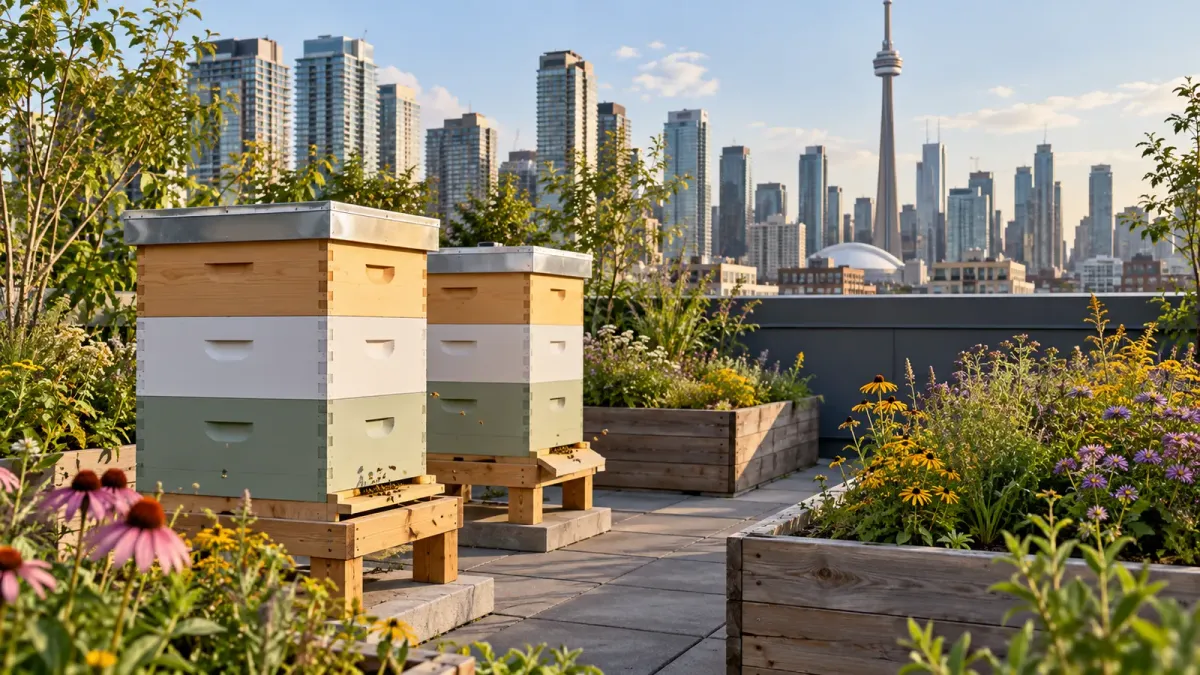
The hero is an AI-generated rooftop illustration, not a verified Toronto apiary or a setback-compliance diagram.
Frequently asked questions
Can you keep bees in a Toronto backyard?
Only where the site complies with Ontario’s Bees Act and applicable property and municipal requirements. Many small backyards cannot meet the provincial boundary distances.
Does Toronto Chapter 349 exempt rooftop hives from setbacks?
The Chapter 349 text reviewed does not establish a general rooftop or flyway-barrier exemption from Ontario’s Bees Act. Confirm the provincial placement rules and the building’s requirements separately.
Does a Toronto community garden automatically allow bees?
No. Get the operator’s written approval and check the site agreement, provincial distances and relevant municipal requirements. An urban-agriculture project is not a general exemption.
Who registers Toronto honey bee colonies?
Ontario’s Apiary Program registers owners or possessors of honey bees and used equipment. Provincial registration does not replace permission from the building owner or land manager.