Ontario Beekeeping Laws: Registration & 30-Metre Rule
By UrbanBee Editorial TeamSources checked Oct 14, 2026
⚠️ Not Legal Advice: Summaries for educational purposes only. Verify with official Ontario authorities.
Ontario beekeeping laws require a valid provincial registration certificate for people who own or possess honey bees or used beekeeping equipment. The Bees Act also restricts hive placement near specified neighboring land and highways. Small residential yards can be unsuitable even when the municipality supports urban agriculture.
Before purchasing a colony, measure the proposed location against the actual property boundaries and road, then confirm the site with Ontario’s Apiary Program and the municipality. A fence, roof location or neighbor’s agreement should not be treated as an automatic exception to provincial law.
Ontario Bees Act requirements compared
| Topic | Provincial requirement | Next step |
|---|---|---|
| Registration | Valid certificate for bees or used beekeeping equipment | Apply through the OMAFA Apiary Program |
| Registration fee and renewal | Registration service is free; keep the certificate valid | Use its expiry date and current renewal instructions |
| Permits | Selling and importing bees or used equipment can require permits | Verify documents before the transaction or movement |
| Hive allowance | No single province-wide residential hive quota | Check local land use and whether the location complies |
| Setbacks | 30 m from specified adjoining-land boundaries; 10 m from a highway | Measure the correct reference points; ask about uncertain cases |
The governing statute is the Bees Act, R.S.O. 1990, chapter B.6. It is separate from municipal zoning and permission to use someone else’s land.
What the 30-metre setback actually measures
Ontario’s official regulatory summary identifies boundaries separating the hive property from land occupied by a dwelling, or used for a community centre, public park or another public assembly or recreation space. The legal wording matters: the rule is not simply a distance measured to the neighbor’s house.
Section 19 also addresses a 10-metre highway distance. Ask the program how the relevant road boundary and hive position should be assessed if the site plan is unclear.
On a narrow urban lot, a hive near the back fence can fail the provincial requirement even though there is a tall screen and no observed nuisance. Use our guide to navigating residential property setbacks to organize the property questions. It explains a general workflow; Ontario’s statute controls the provincial distance test.
Our review of Toronto municipal bylaw exemptions explains why a city program or rooftop installation cannot, by itself, waive that test.
Register before acquiring bees or used equipment
The current registration page uses the ministry name Ontario Ministry of Agriculture, Food and Agribusiness (OMAFA). Older material may refer to OMAFRA.
Provide accurate bee-yard locations, colony numbers and contact information. Retain the certificate and renew before it expires. A registered owner may still need registration when colonies have been sold but used equipment remains in their possession.
Registration allows access to inspection and permit services; it does not approve a setback, roof structure or municipal land use. Add a renewal reminder using the certificate’s actual expiry rather than assuming every approval follows the same calendar date.
Buying, selling and moving bees
The Ontario selling-permit guidance covers colonies, nucs, packages, queens, queen cells, brood frames and used equipment. Selling or giving away bees can require the appropriate permit and inspection.
Before accepting a nuc, ask the seller for the permit details, the originating yard and the inspection record relevant to the sale. Compare inspected nucs versus packages when choosing the colony format; neither format bypasses provincial biosecurity requirements.
Importing bees or used equipment from outside Ontario is a separate permit question. Routine movement of your own hives should be discussed with the program where restrictions, disease status or destination requirements are uncertain.
Disease control and winter preparation
Maintain inspection records and report suspect pests or diseases as directed by the Apiary Program. Do not expose honey, diseased comb or dead-out equipment to robbing bees, transfer suspect brood to another colony, or assume a supplier’s inspection protects the hive indefinitely.
Winter preparation is sound husbandry: assess stores, monitor Varroa and use only treatments authorized for the intended use. The CFIA biosecurity guide helps structure equipment hygiene and records. It does not replace instructions issued after an Ontario inspection.
Keep registration, site permission, selling documents and hive-health records together. That makes it easier to answer an inspector’s questions and detect when a planned change needs another approval.
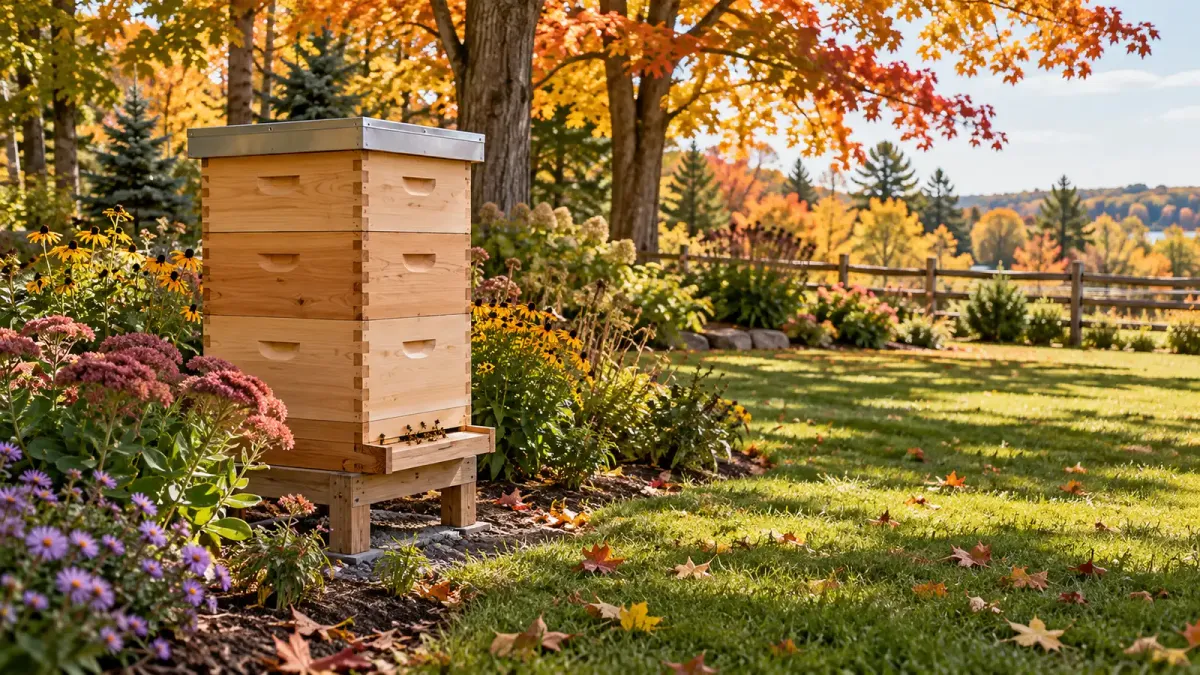
The hero is an AI-generated illustration; its garden layout does not demonstrate a measured statutory setback.
Frequently asked questions
What is Ontario’s 30-metre beehive rule?
Section 19 restricts hives containing bees within 30 metres of a boundary adjoining land occupied as a dwelling or used for specified public assembly or recreation purposes. The Act also addresses hives within 10 metres of a highway.
Can a fence waive the Ontario Bees Act setback?
Do not assume so. The provincial sources reviewed do not provide a general flyway-fence or rooftop exemption. Ask the Apiary Program to confirm the statutory requirements for your site.
Do hobby beekeepers in Ontario need registration?
Yes. Owners or possessors of honey bees or used beekeeping equipment need a valid provincial registration certificate, including hobbyists. Renew before the expiry shown on the certificate.
Do I need a permit to sell a nuc or queen?
Ontario requires the applicable selling permit for live bees and used beekeeping equipment, supported by inspection. Check the current Apiary Program process before selling or giving away bees.