Bee Hive Removal Cost: Calculator, Quotes & Repairs
General bee removal runs about $150–$500 in Angi’s July 2026 cost guide, but bees inside a wall or roof can cost much more to remove. One Central Pennsylvania specialist lists structural jobs from $650 to $1,200 or more, before permanent repairs. At the other end, some beekeepers collect an accessible outdoor swarm for free.
Before booking, send a photo taken from a safe distance and ask for a quote covering the bees, comb and honey cleanup, access, sealing, and repairs. Check the repair line especially: a quote to remove bees from behind siding may not include putting the siding back and matching the finish.
Safety alert: Keep people and pets away from the colony. Do not spray, disturb, or seal an active entrance before a qualified professional assesses it. Never climb onto a roof or open a wall to improve a quote photo. Call emergency services for immediate danger to life or a medical emergency.
How Much Does Bee Hive Removal Cost?
The U.S.-dollar figures below combine a consumer cost guide with one specialist’s advertised Central Pennsylvania prices, checked September 5, 2026. The regional examples are not national averages. Use them to plan questions, then get a local quote that lists fees and exclusions.
| Situation | Published price reference | Scope and limitation |
|---|---|---|
| Accessible cluster on a branch or fence | Free with some beekeepers; Angi lists paid swarm collection at $125–$200 | A swarm without an established structural nest; availability and travel matter |
| General bee removal | Angi: $150–$500 | Broad consumer estimate covering different jobs; not a complete wall-cutout allowance |
| Accessible structural colony | Been’s Bees, Central Pennsylvania: $650 | Provider’s standard ground-level or low-eave job; permanent repairs excluded |
| Second-story or more difficult structural access | Been’s Bees: $750–$1,000 | Provider’s moderate-access category; assess the actual building |
| Tall roof or hard-access chimney | Been’s Bees: $1,200+ | Provider’s complex category; no universal maximum |
| Extermination | Angi: $150–$1,000 | Check whether the price includes physical nest removal and cleanup |
| Drywall restoration | Angi: $275–$750 | Separate repair estimate; opening size, finish, and local labor affect the quote |
Price sources: Angi’s removal cost guide and Been’s Bees’ published Central Pennsylvania pricing. The provider example illustrates an actual advertised scope, not an endorsement or a price promise for another city.
A colony on the outside of a shed is not necessarily a simple swarm. If comb is already attached under a roof or inside siding, describe that when requesting an estimate. Likewise, bees entering a chimney might occupy a cavity beside the flue rather than the flue itself; inspection determines the access plan.
Live Beekeeper Removal vs. Extermination
A pest-control company may offer live removal, and a beekeeper may hire another contractor to repair your wall. Ask two questions before comparing prices: “What happens to the bees?” and “Who cleans out and closes the opening?”
| Quote item | Live structural cutout | Extermination or treatment |
|---|---|---|
| Bees | Captured for relocation where feasible | Killed using an authorized treatment |
| Comb, honey, and brood | Should be explicitly included in the agreed extraction scope | May require a separate cleanup visit or contractor |
| Opening the structure | Often necessary to reach the colony | May still be necessary for cleanup even after treatment |
| Permanent restoration | May be included, subcontracted, or excluded | May be included, subcontracted, or excluded |
| Best question to ask | “What happens if some comb cannot be reached?” | “Who removes the nest material after treatment?” |
For an explanation of the options, read our guide to humane methods to get rid of bees.
Why comb removal affects the total bill
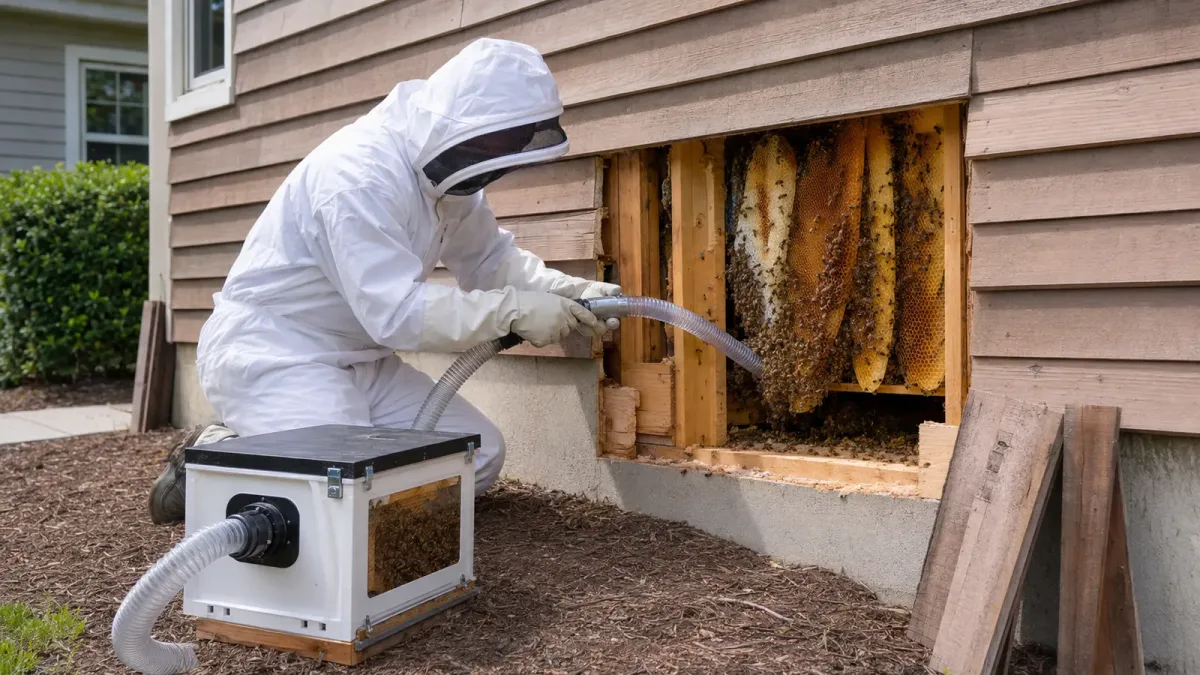
University of California IPM explains that removing a colony from a building is substantially harder than collecting a swarm. If a colony is killed and left in place, honey can ferment and leak, and decomposing bees can produce odors. Its guidance emphasizes agreeing on cavity cleanup and restoration before work starts.
Ask for photos after cleanup, before the opening is closed. If some comb cannot be reached, get a written explanation of what remains and how it will be handled. Collecting visible bees with a vacuum does not prove the nest behind the wall is gone.
Is a trap-out a cheaper option?
A trap-out redirects departing bees into another hive rather than immediately opening the structure. UC IPM describes it as an option requiring time and expertise. It does not automatically solve the question of comb and honey left in the cavity.
If it is proposed, request a separate explanation of follow-up visits, completion criteria, remaining nest material, and final sealing. Compare that full plan with a cutout quote rather than assuming less demolition always means a lower total cost.
What Makes a Bee Removal Quote Higher?
Height and access equipment
A ground-level opening may be reachable with ordinary work access. A roofline, steep slope, confined yard, or upper-story chimney may need different equipment and staffing. Ask whether the estimate includes equipment rental, delivery, setup, and any extra rental days.
Let the contractor decide safe access. Do not offer an unsecured household ladder or attempt to remove roof coverings to lower the bill.
Building materials and hidden services
Drywall, cedar siding, brick, stucco, and roofing require different opening and restoration methods. The cheapest route to the bees may not produce the cheapest finished repair.
Ask the provider to identify the preferred access side and explain the effect on weatherproofing and interior finishes. Before work begins, agree who handles concealed pipes, wiring, unexpected deterioration, or a larger-than-expected opening.
Colony extent and number of cavities
The size of the entrance is a poor basis for a fixed estimate. Ask whether the quote covers one cavity or every connected area the colony occupies, and what happens if the inspection finds a second colony.
Avoid paying based on an unsupported claim about the exact number or weight of bees. The more useful information is the documented location, extent of work, and access required.
Scheduling, travel, and return visits
Ask whether the quoted amount changes for same-day work, evenings, distance, parking, or a return visit. If the bees present no immediate danger, a scheduled appointment may offer more choices than an emergency callout.
Have the provider distinguish an inspection charge from a removal charge. If the inspection fee is credited toward the job, put that credit in the written estimate.
When Will a Beekeeper Remove Bees for Free?
A reachable cluster on a branch or fence is the best candidate for free or donation-based collection. You still need the property owner’s permission and an available local beekeeper; not every swarm can be collected safely or without a travel charge.
When contacting a club or collector, provide:
- Your town and approximate location
- A photo taken safely without approaching the cluster
- Whether the bees are on an exposed surface or entering a hole
- How long you have noticed them
- An approximate height estimated from the ground
- Whether anyone has already applied a pesticide
- Whether the person arranging removal owns or manages the property
State your budget openly, then ask about travel fees, donations, and minimum charges before a visit. A collector may decline a job because of access, distance, suspected contamination, or limited capacity.
An established wall colony is a different job. Recovering the bees does not cover the hours spent opening the wall, removing comb, transporting the colony, and making repairs. Also confirm that you have honey bees: a swarm collector may not handle wasps or hornets.
For immediate, noninvasive steps while arranging help, see what to do when a bee swarm lands in your yard.
Budget for the Whole Job
Use this structure when comparing estimates:
Total project cost = inspection + removal + access equipment + nest cleanup + sealing + permanent repairs + applicable fees.
Do not add a line twice if it is already bundled into removal. Mark an unpriced item as “not quoted” rather than treating it as free.
Use the calculator below or open the bee removal cost calculator to compare itemized ranges and download your budget with a claim-document checklist.
Estimate Your Bee Removal Budget
Enter amounts from local written quotes in U.S. dollars. Choose Included / not needed only when confirmed; leave unpriced work as Not quoted. This adds your scope items rather than predicting a market price or insurance payment.
Controls are loading. You can sum the quote items manually using the guide below.
Entries stay in this browser. The example is hypothetical: $800 extraction with inspection, access and cleanup bundled, $100 sealing and $450 repairs. Tax and other fees remain unquoted. Read the cost and hiring guide and insurance questions before booking.
A sample budget, not a market quote
Suppose a written estimate contains the following hypothetical amounts:
| Line item | Example amount |
|---|---|
| Assessment, credited if the job proceeds | $0 net |
| Live extraction, access, comb cleanup, and transport | $800 |
| Temporary weather protection and entry sealing | $100 |
| Permanent siding repair and finish | $450 |
| Total before any applicable tax or additional authorized work | $1,350 |
These numbers are invented to demonstrate budgeting. They show why an $800 removal quote can become a $1,350 finished project without the removal price itself changing.
Ask whether “repair included” means a temporary cover, reattaching existing boards, replacing damaged material, or fully matching paint and finish. For masonry, roofing, or extensive water damage, request the appropriate contractor’s estimate before committing to a total budget.
Hiring Checklist: Credentials, Insurance, and Guarantees
Legal alert: Requirements depend on location and method. Check the relevant state agency before hiring a removal or pesticide provider, and obtain the property owner’s permission before opening a structure. The EPA explains that pesticide labels are legally enforceable; a product sold for outdoor insects is not automatically authorized for a wall cavity.
A directory listing is only a starting point. For example, Texas Apiary Inspection Service states that its removal list is not an endorsement, does not establish training or qualifications, and is not a bee-removal license.
Before accepting a quote, ask:
- Who performs each part? Identify the bee remover, access contractor, repair contractor, and anyone subcontracted.
- What credentials apply? Verify relevant registration or licenses directly with the issuing agency for the proposed work.
- Is the work insured? Request current evidence of liability coverage and ask about the scope of removal and construction work. Ask about workers’ compensation where applicable.
- What is included? List bees, comb, honey, debris, access, temporary protection, entry sealing, permanent restoration, and disposal.
- How are changes approved? Require agreement before extra work; specify the price or how it will be calculated.
- What does the guarantee cover? Ask whether it applies to the treated entry, surviving bees, a new swarm, leakage, repairs, or only a return inspection.
- Who responds after the job? Record the follow-up contact, expected response time, and possible charges.
An advertised “lifetime guarantee” is not enough to compare offers. Read the written conditions, exclusions, transferability, and maintenance requirements.
Does Homeowners Insurance Pay?
Check the policy before assuming removal or repairs will be reimbursed. Ask the insurer to consider the infestation, access opening, cleanup, and any separately covered damage as individual items.
Our guide answering does homeowners insurance cover bee removal provides the questions to ask. Save photos, itemized estimates, invoices, and the insurer’s written response. A contractor’s willingness to submit paperwork does not establish coverage.
Documents to Gather Before a Bee Removal Claim
Insect damage is commonly excluded from homeowners policies, as the Texas Department of Insurance explains. Ask your insurer about the actual policy and any separately covered damage before assuming reimbursement.
- Record the condition: date first noticed, safe-distance photos, affected rooms and any leak or other damage. Do not disturb the colony or open a structure for evidence.
- Ask about authorization: policy wording, exclusions, deductible, reporting deadlines, inspection requirements and any approval needed before nonemergency work.
- Separate the costs: keep itemized removal, access, cleanup, sealing and permanent repair estimates. Ask who approves additional work.
- Keep a dated file: claim number, communications, approved changes, before/after cleanup photos, invoices and receipts.
- Get the decision in writing: ask which policy provision supports payment or denial and which review options are available.
For policy questions beyond removal, see our beehive and homeowners insurance guide. A budget calculation does not determine coverage.
Frequently Asked Questions
How much does bee hive removal cost?
Published general estimates start around $150–$500, but structural honeybee removal can be substantially higher. Use the cited examples above to understand the scale, then obtain a written local estimate covering access, cleanup, sealing, and repairs.
Will a beekeeper remove bees for free?
Some collect accessible outdoor honeybee swarms for free or a donation. Availability varies, and established colonies in walls, roofs, and chimneys normally require paid specialist work.
Is extermination cheaper than live bee removal?
It may have a lower initial treatment charge, but there is no universal winner. Compare both options after including nest cleanup, access, sealing, repairs, and follow-up.
Does bee removal include drywall or siding repairs?
Not automatically. Ask whether the quote covers temporary protection, basic closure, or full permanent restoration, and identify who provides the repair warranty.
Prices and linked guidance checked September 5, 2026. Published estimates can change; the agreed local scope and written quote determine your project’s cost.