Is It Illegal to Kill Bees? Honey Bee Laws by State
There is no blanket federal ban on killing European honey bees (Apis mellifera) in the United States. They are not federally listed as endangered. That does not make every removal legal: pesticide labels, state and local rules, property rights, and licensing requirements still apply. Protected native bees are a separate case.
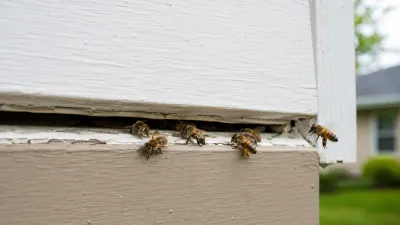
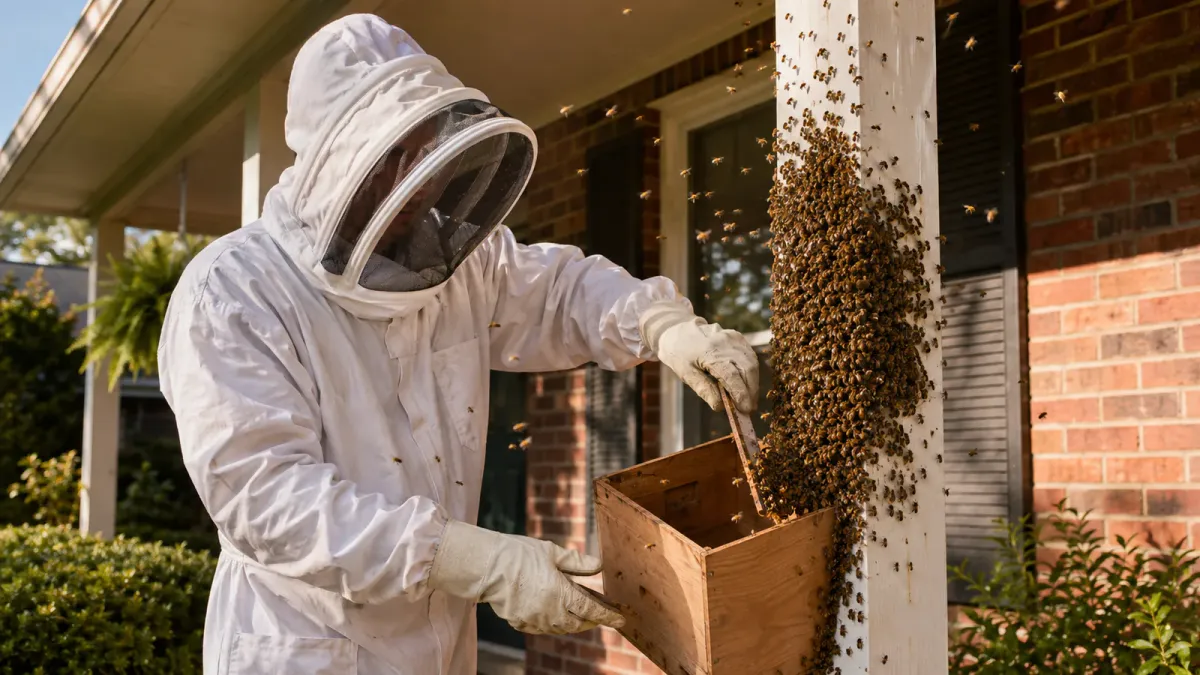
If bees are present now, do not spray or seal the entrance. Keep people and pets away, photograph the insects from a safe distance, and call a local swarm catcher or qualified bee-removal professional. Call emergency services for trouble breathing, face or mouth swelling, throat tightness, fainting, or an active mass-stinging event.
Legal alert: This is general U.S. educational information, not legal advice. Bee, pesticide, nuisance, wildlife, and contractor rules vary by location and can change. Verify the current rules for the exact property with the state agriculture or pesticide agency and the relevant local government.
Are Honey Bees Protected by Federal Law?
The federal Endangered Species Act protects species that are formally listed as threatened or endangered. The familiar European honey bee is not on the current federal wildlife list. The U.S. Fish and Wildlife Service lists certain native bees - including the rusty patched bumble bee - as endangered.
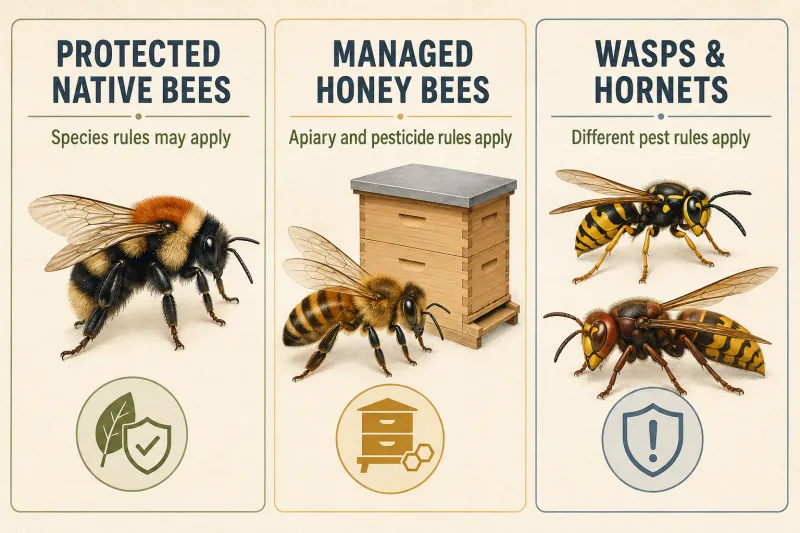
Start by finding out which insect you have. A bumble bee nesting under a shed, a honey bee swarm hanging from a branch, and yellowjackets entering a wall can require different responses - and fall under different rules.
| Insect or situation | General federal status | Best first action |
|---|---|---|
| European honey bee (Apis mellifera) | Not federally listed as endangered; managed colonies are agricultural resources | Confirm it is a honey bee, then seek live removal where practical |
| Federally listed native bee, such as the rusty patched bumble bee | Protected under the Endangered Species Act | Do not disturb it; contact the U.S. Fish and Wildlife Service or a state wildlife agency |
| Unidentified ground or cavity nest | Status cannot be determined from “bee” alone | Photograph from a safe distance and obtain expert identification |
| Wasp, yellowjacket, or hornet | Not a honey bee; different pest and wildlife rules may apply | Assess the hazard and use a qualified pest professional when needed |
Federal law still matters even when the insect is not endangered. The U.S. Environmental Protection Agency explains that pesticide labels are legally enforceable. Using a registered pesticide in a way that conflicts with its label can violate federal law, including when the product is used at home.
Honey Bee Laws by State: Texas, Florida, California, and Illinois
In these four states, the rules focus on how removal is done and who does it, rather than a blanket ban. Hiring someone to treat bees in a wall raises different licensing questions from having a beekeeper collect a swarm from a branch.
| Jurisdiction | Is there a blanket ban on killing honey bees? | What the official rules actually focus on |
|---|---|---|
| Federal | No blanket ban for European honey bees | Listed-species protection and legal pesticide use |
| Texas | No blanket statewide ban identified | Apiary health and movement rules; registration for bee-removal exemptions; structural pest-control licensing; local rules |
| Florida | No; FDACS expressly says licensed eradication of a nuisance colony is not illegal | Registered live removers, licensed eradication providers, apiary registration, and public safety |
| California | No general statewide ban identified | Pesticide compliance, structural pest-control licensing and exemptions, apiary registration, and local property rules |
| Illinois | The Bees and Apiaries Act is not a blanket kill ban | Registration, inspection, disease control, quarantine, abatement authority, and local rules |
Texas
Texas Agriculture Code Chapter 131 regulates bees and honey, including colony health, movement, and the Texas Apiary Inspection Service. TAIS says a beekeeper must maintain current registration to perform non-pesticide bee removal under the beekeeper exemption from the Texas Structural Pest Control Act. Pesticide-based work generally belongs with a licensed structural pest professional, and no exemption authorizes off-label use.
A homeowner and a person offering paid removal are not necessarily governed the same way. Before acting or hiring someone, review Texas apiary and beekeeping regulations, check the city or county code, and verify the provider’s current registration or pest-control license as appropriate.
Florida
Florida offers one of the clearest official answers. The Florida Department of Agriculture and Consumer Services says it is not illegal for a licensed pest control company to eradicate a nuisance honey bee colony. FDACS also says registered beekeepers may provide live removal and that, without proper equipment and training, a homeowner should never attempt removal or eradication.
Florida requires managed apiaries to be registered and distinguishes live removal from pesticide-based eradication. See the Florida Department of Agriculture apiary rules before keeping bees or choosing a provider.
California
California has no single statewide rule that makes every honey bee untouchable. State law instead regulates pesticide use and structural pest-control work. California Business and Professions Code § 8555 includes an exemption for pest control performed on property a person owns, leases, or rents, while non-pesticide live capture or exclusion of bees from a structure has a separate exemption tied to insurance requirements. Those exemptions do not cancel pesticide-label directions, environmental restrictions, or local law.
The Healthy Schools Act governs pesticide use at schools and child-care facilities; it is not a general honey bee protection law for every residence. For a swarm on a sidewalk, park, road verge, utility easement, school, or other public or controlled property, do not spray it yourself. Contact the property owner, responsible agency, or local non-emergency service because permission and site-specific rules control.
Illinois
The Illinois Bees and Apiaries Act requires people keeping colonies to register with the Illinois Department of Agriculture and gives the department inspection, quarantine, and abatement authority for disease, parasites, exotic strains, and certain nuisances. Those managed-apiary provisions do not make every feral European honey bee a protected species.
Illinois is also within the historic range of the rusty patched bumble bee, which is listed as endangered under both federal and state law. Local zoning and nuisance codes may add requirements, so verify the insect and the municipality before treating a nest.
Can a Homeowner Spray a Hive on Their Property?
Homeownership does not override pesticide labels or local restrictions. Before considering a treatment, check:
- Is the insect correctly identified? A protected native bee, honey bee, and yellowjacket are not interchangeable.
- Does the label permit this exact use? The product, target pest, site, dose, application method, protective equipment, and re-entry directions all matter.
- Could the application leave the property? Drift or runoff can expose neighbors, pets, gardens, water, and managed hives.
- Is the colony inside a structure? Killing adult bees does not remove wax, brood, honey, or the entry route.
- Do local rules or private agreements apply? A city code, lease, HOA rule, condominium policy, or public-property restriction may control the site.
Safety alert: Never pour gasoline, bleach, solvents, or improvised mixtures into a nest, and never use fire. Do not climb a ladder, open a wall, or approach a defensive colony without the training and protective equipment needed for that job.
Spraying an established wall colony can turn one problem into several. Surviving bees may find a route into living space. Dead brood can decay, and unguarded honey and wax can attract ants, beetles, rodents, or another swarm.
Honey or comb exposed during a structural pesticide treatment should not be harvested for food unless the product labeling expressly permits that use and all applicable food-residue requirements are met.
There is also liability beyond the pesticide label. Drift, contaminated honey, damage to someone else’s colony, or injuries caused by an unsafe treatment may produce a complaint or civil claim. Before authorizing structural work, document the colony and review possible bee removal insurance coverage.
When Is Eradication a Reasonable Option?
Live removal is usually preferable, but it is not always the safest or most feasible option. A qualified provider may recommend eradication when:
- a colony presents an immediate, serious stinging hazard in a school, care facility, busy entrance, or occupied structure;
- defensive behavior makes a live cutout unsafe;
- the nest cannot be accessed without unacceptable risk to workers or occupants;
- emergency responders or the responsible public agency directs hazard control; or
- live-removal providers decline the job and applicable law permits a licensed pest professional to proceed.
“Africanized” should not be a visual DIY diagnosis. FDACS notes that African and European honey bees cannot be reliably distinguished by sight and that genetic testing is required. Treat unusually defensive behavior as a safety signal, clear the area, and let a qualified professional assess it.
Emergency safety alert: If a colony is actively attacking, get indoors or into a closed vehicle, protect your face and airway, and call 911. Do not jump into water, swat at bees, or stop to retrieve belongings.
Humane Alternatives to Killing Honey Bees
The right service depends on whether the bees are resting in the open or living inside a cavity.
| Situation | Preferred response | What to expect |
|---|---|---|
| Temporary swarm on a branch, fence, or railing | Local beekeeper or swarm catcher | Often free or low cost when safely accessible; collection may happen the same day |
| Established colony in a wall, soffit, chimney, or roof | Professional live cutout | Bees, brood, honey, and comb are removed; the opening must then be repaired and sealed |
| Colony in a cavity that cannot be opened | Specialist trap-out, where suitable | Takes weeks and may leave comb behind; follow-up exclusion work is essential |
| Immediate high-risk colony where live removal is unsafe | Licensed eradication professional | A last-resort safety response; comb removal and structural cleanup may still be required |
For a hanging swarm, contact a local beekeeping association quickly and send a clear photo, exact height, access details, and whether the cluster is on public or private property. Many swarm catchers collect accessible honey bees at no charge because the colony can be rehoused.
For bees inside a building, ask whether the quote includes locating the nest, removing all comb and honey, finding or containing the queen, repairing the opening, and sealing entry points. Our guide to humane bee removal methods explains the difference between swarm pickup, cutouts, and exclusion.
Frequently Asked Questions
Is it illegal to kill honey bees in the United States?
There is no blanket federal ban on killing European honey bees. However, a removal can still break pesticide, state, local, or property laws. Protected native bee species have separate legal protections.
Is it illegal to kill honey bees in Texas?
Texas does not have a blanket statewide ban on killing every honey bee. Paid removal and pesticide work can trigger registration or structural-pest-control requirements, while federal pesticide labels and local nuisance and property rules still apply.
Is it illegal to kill honey bees in Florida?
Florida says a licensed pest control company may legally eradicate a nuisance honey bee colony. Live-removal providers must meet FDACS registration rules, and FDACS advises homeowners not to attempt removal or eradication without the proper equipment and training.
Are all bees protected because some bee species are endangered?
No. Species status matters. The managed European honey bee is different from federally listed native species such as the rusty patched bumble bee. Identify the insect before taking action and check current federal, state, and local rules.
Legal sources checked September 4, 2026; wording updated September 5, 2026.