Bees in House Walls: Safe Removal and Cutout Guide
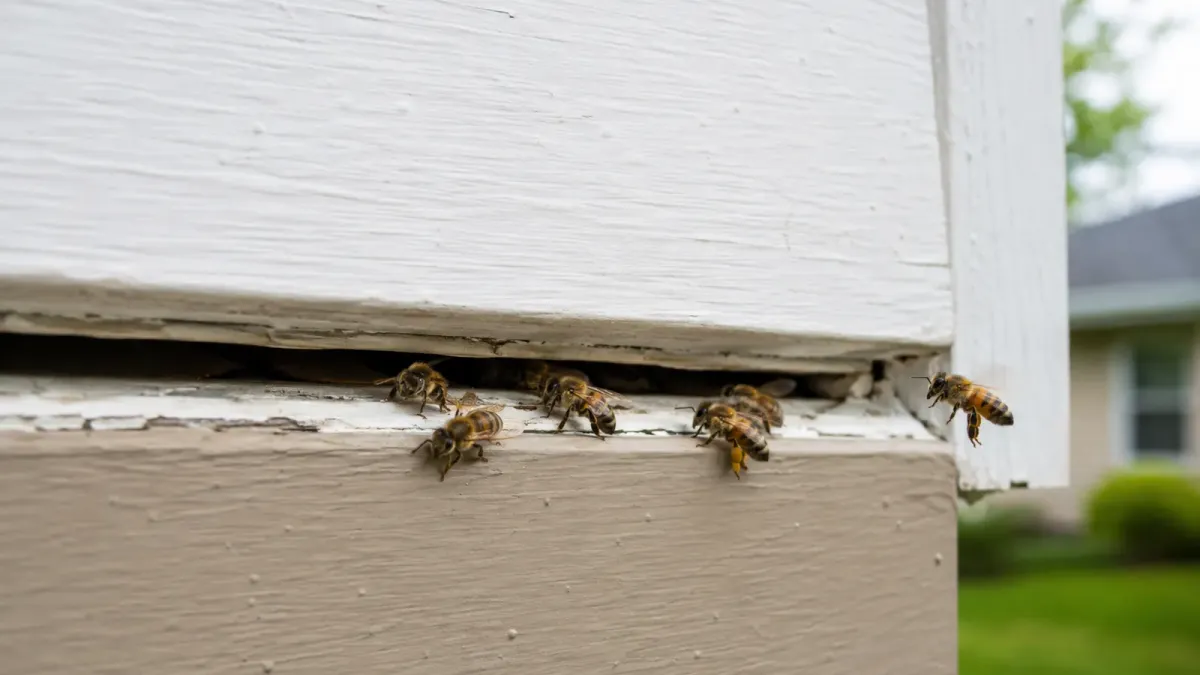
If honey bees are entering your house wall, leave the active entrance open, keep people and pets away, and call a specialist who handles structural bee removal. Ask whether a live cutout is possible and whether the quote includes removing comb and honey - not just the visible bees.
Send a photo or short video taken from a safe distance, the entrance’s approximate height, and the date you first noticed activity. Tell the remover if bees are coming indoors or anyone has already sprayed or sealed the gap. Do not open the wall to get a better look.
Safety alert: Do not inject spray, foam, smoke, or household chemicals into an occupied wall. Avoid drilling, removing siding, or climbing to reach the entrance. If bees attack, get into an enclosed vehicle or building; call emergency services for an immediate threat to life or a severe sting reaction.
Why You Should Not Seal Bees Inside a Wall
Caulk looks like a quick fix when the entrance is only a small crack. The problem is what happens behind it. Trapped bees can seek another exit, including one into the house, according to Texas A&M AgriLife Extension.
An entrance also does not mark the exact nest location. Do not assume the colony is directly behind the visible hole.
If you have already blocked it, tell the remover what you used and when. Keep away from the affected area and ask for instructions; do not start pulling out the plug or spraying emerging bees.
Will trapped bees eventually die?
Possibly, but “wait a few days” is not a dependable removal plan. You cannot tell from outside whether the colony has another exit or how much food remains. A quiet entrance does not establish that the cavity is empty.
Death would not remove the nest, either. UC IPM describes how dead bees and brood can create odors and stored honey can ferment and leak. For help interpreting a smell, see identifying dead bee and hive odors. Odor alone cannot identify what is behind a wall.
Signs of Honey Bees Behind Siding or Drywall
Repeated traffic into one opening is worth investigating. Returning insects carrying pollen are a stronger clue than a single bee exploring a seam. University of Georgia Extension identifies pollen-carrying traffic as a sign of a nesting colony.
| What you notice | What it can tell you | What to report |
|---|---|---|
| Repeated arrivals and departures at a siding gap | Insects may be nesting inside | Location, activity times, and a safe-distance video |
| Yellow pollen loads on returning bees | Supports honey-bee colony identification | A clear photo if available without approaching |
| Buzzing behind drywall | Helps narrow the inspection area, but is not a species ID | Which room and wall |
| A warm area on the wall | May help a specialist locate activity; not proof by itself | Mention it without drilling or probing |
| Bees appearing indoors | Raises the urgency of an assessment | Room, approximate number, and recent sealing or treatment |
Not every insect entering a building is a honey bee. Have the species confirmed before agreeing to a removal method. A specialist may use sound or heat clues to locate the nest; the homeowner’s job is to describe the activity, not expose it.
Cutout vs. Trap-Out: Which Removal Fits?
A cutout opens the building to reach the nest. A trap-out uses a one-way exit to keep departing bees from returning through that entrance. Neither name tells you whether repairs are included.
| Question | Live structural cutout | Specialist trap-out |
|---|---|---|
| Does the wall need opening? | Usually, from the interior or exterior | May avoid an immediate opening |
| What happens to the comb? | Removed through the access opening | Remains unless separately accessed |
| What should the proposal explain? | Access, extraction, cleanup, and restoration | Follow-up visits, remaining nest material, and completion checks |
| What is the main trade-off? | Direct access, with building repairs afterward | Less initial disruption, but unresolved cavity contents may remain |
| What should you ask? | “Who closes and finishes the opening?” | “How will you confirm this is finished?” |
What a live cutout involves
UGA Extension describes a specialist exposing the nest, collecting bees, and removing the comb. Depending on its position, access may be from inside or outside the house.
Before approving that opening, ask for a marked photo or sketch showing where the work will happen. Agree who is responsible for protecting furnishings, checking for hidden services, and making the building weather-tight afterward.
Get these items in writing:
- Whether the bees will be relocated and who takes responsibility for them
- Whether all accessible comb, honey, and debris are included
- What happens if the colony extends into another cavity
- Whether closure means a temporary cover or a finished repair
- How additional work will be priced and approved
When a trap-out may be considered
UC IPM describes a one-way trapping method as an option requiring patience and knowledge. It is not the same as plugging the hole.
Do not accept “no cutting needed” as the whole proposal. Ask the specialist to explain the follow-up schedule, what happens if bees use another entrance, and the plan for comb left inside. Avoid treating a quoted number of weeks as a guarantee.
If the plan mentions transferring trapped bees to a nuc box, that linked guide explains what a nucleus colony is. It is background reading, not a wall trap-out tutorial; ask the specialist how the receiving colony will be managed.
What If Live Removal Is Not Feasible?
Ask the contractor to explain the access or safety problem and what alternatives they considered. Treatment may be proposed, but “the bees are dead” and “the wall is restored” are different completion points.
Legal alert: Check local removal and pesticide credentials before hiring, and obtain the property owner’s permission before structural work. Pesticide use must follow the product label; an outdoor insect spray is not automatically suitable for a wall cavity. The EPA explains that pesticide labels are legally enforceable.
Also ask about liability coverage and relevant building-repair experience. A directory listing is not proof of either: TAIS explicitly says its removal list is not an endorsement or a bee-removal license.
Cleanup and Repairs: Agree on the Finish Before Work Starts
Ask for photographs before the cavity is closed. They give you a record of the removal and help clarify any repair work still outstanding.
Use this short handover checklist:
- The remover has explained what was removed and anything left behind.
- Any treatment used is recorded, with handling instructions for affected material.
- The repair contractor knows where access was made.
- Damaged insulation and finishes have been assessed.
- Temporary weather protection and permanent restoration have named owners.
- Follow-up contact details and guarantee exclusions are in writing.
For budgeting, compare average bee removal and cutout costs, including the qualifications attached to the published estimates. A wall job needs a local quote; a general bee-removal price may omit carpentry entirely.
Prevent another colony without blocking drainage
After removal, coordinate exclusion with the repair contractor. Close unintended access gaps, but do not indiscriminately fill every opening with expanding foam.
Some openings serve the building. UGA Extension recommends screening where ventilation is needed; ask the contractor for an insect-excluding detail that also preserves drainage and airflow. Have them check the surrounding siding, trim, and service penetrations rather than treating only the original entrance.
What if bees return after the job?
A few workers outside the former entrance can occur after removal, as UGA Extension notes. Send the remover a short video and describe whether bees are merely gathering outside or repeatedly entering an opening.
Use the agreed follow-up plan. Do not add pesticide or caulk on your own, especially if the contractor still needs to inspect the site.
Frequently Asked Questions
If an odor persists, tell the removal specialist where and when you notice it. Our dead-bee odor guide explains why smell alone cannot identify what remains in a wall cavity.
How do you get rid of honey bees in a house wall?
Have a structural bee-removal specialist identify the insects and locate the nest. Ask about a live cutout and get a written plan for comb removal, cavity cleanup, entry sealing, and permanent repairs.
Will bees die if trapped in a wall?
They may eventually die, but there is no reliable countdown for a hidden colony. Sealing an active entrance can redirect bees indoors and still leave nest material behind. Arrange an inspection instead of trying to starve them out.
Can bees be removed without opening the wall?
Sometimes a specialist can use a trap-out, which lets departing bees leave through a one-way exit. It needs follow-up and does not physically remove the comb. Ask how remaining nest material will be handled before choosing it.
When can I seal the hole after bee removal?
Let the removal specialist confirm that exclusion can proceed. Coordinate sealing with cleanup and repairs, and preserve any drainage or ventilation openings the building needs.
Sources checked September 5, 2026. Hero image is AI-generated for illustration, not a photograph of an inspected property.