Bee vs. Wasp vs. Hornet: How to Tell Them Apart Fast
Most “bee problems” aren’t bees. The insects raiding your soda can, nesting in your wall void, or patrolling your eaves are usually yellowjackets or paper wasps - and the right response depends entirely on which insect you actually have. Here’s the fast field guide.
The 10-second test
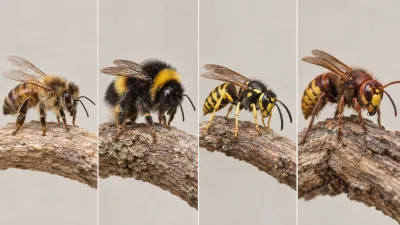
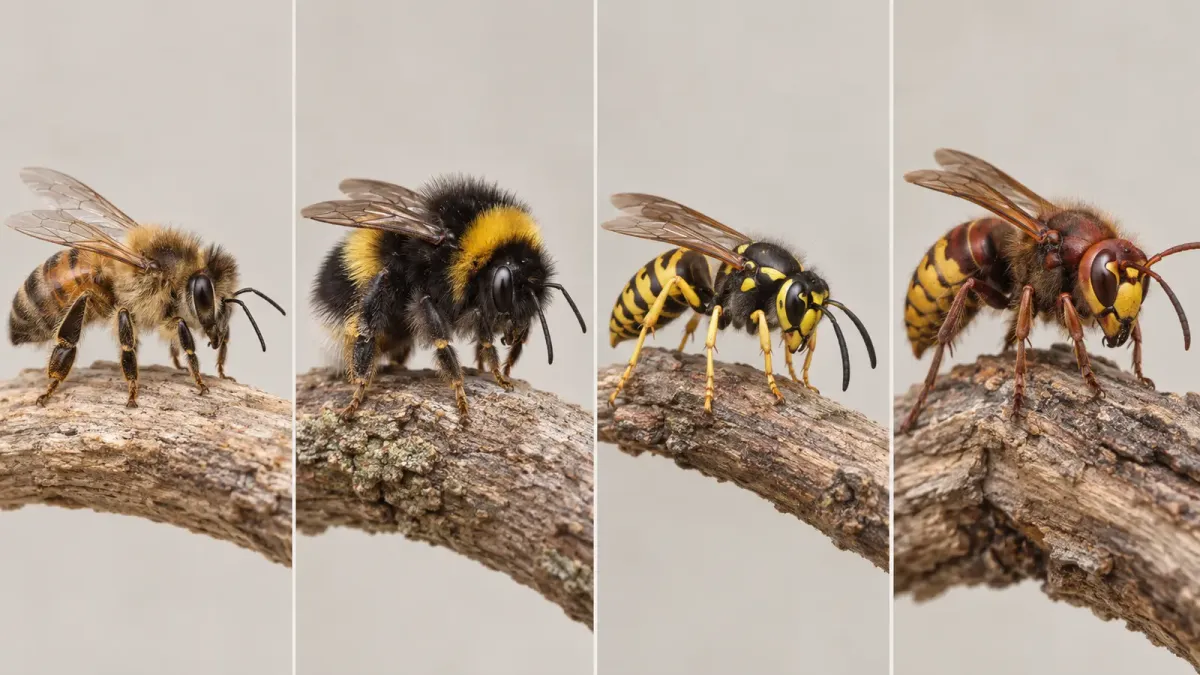
For a fuller comparison of body features, nest clues, and repeated-sting ability, use the bumblebee, honey bee, wasp, and hornet identification guide. The generated hero is illustrative, not a species-verification photograph.
Fuzzy, brown, thick-bodied, on flowers → bee. Smooth, shiny, bright yellow, pinched waist, at your food → wasp. Bees are vegetarian pollen-collectors built like teddy bears; wasps are predators and scavengers built like fighter jets.
Honey bees
Honey bees have a hairy thorax and a banded abdomen. You’ll see them on flowers and at water sources; they may also visit sweets. Workers commonly leave their stinger in human skin and die afterward. A hanging cluster may be a honey bee swarm; keep your distance while arranging identification. Repeated traffic into a wall needs identification before choosing a removal service.
Bumblebees
Big, round, loudly fuzzy, black-and-yellow. Small ground or cavity nests (often old mouse holes), rarely more than a few hundred bees, docile away from the nest, and gone at the end of the season. Superb pollinators - coexist if you possibly can.
Yellowjackets (the usual suspect)
Many yellowjackets are yellow and black with relatively shiny bodies. Some scavenge around picnic food, though food attraction alone is not identification. Nests may be underground, in cavities, or aerial, depending on the species. Females can sting repeatedly, and disturbing a concealed nest while mowing is hazardous. UC IPM describes their varied nesting and feeding habits.
Paper wasps
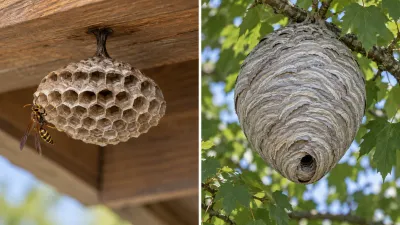
Slimmer, longer-legged, brown-and-yellow or reddish; legs dangle visibly in flight. They build the small open honeycomb umbrellas under eaves and railings. Mostly non-aggressive unless the nest is disturbed - a nest away from doorways can often just be left alone until winter empties it.
Hornets
For nest and body clues within the wasp group, see hornet vs wasp identification.
Large wasps, in the U.S. usually the bald-faced hornet (black and white) building basketball-sized gray paper globes in trees, or the European hornet (large, brown-and-yellow, flies at night). Nest defense is serious; large or high-traffic nests are professional territory.
Why the difference matters
- Response: honey bee swarms get collected free by beekeepers; established bee colonies deserve live removal; yellowjacket and hornet nests near people are legitimate extermination or professional-removal targets.
- Protection: honey bees are managed livestock - in some states legally protected as such - and pollinators generally are worth sparing when the risk is low.
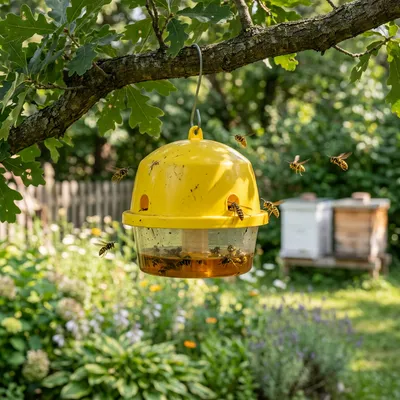
- For beekeepers: wasps and yellowjackets are hive predators. If you keep bees, late summer is wasp-defense season - see keeping wasps away from your hive.
Still unsure? Use zoom from a safe vantage point without approaching a nest, and send the photo and location to your extension office or a qualified local specialist. Identification can require more than one view. If it is a honey bee swarm, a beekeeper may be able to collect it; availability and fees vary.