How Much Honey Does One Bee Make in Its Lifetime?
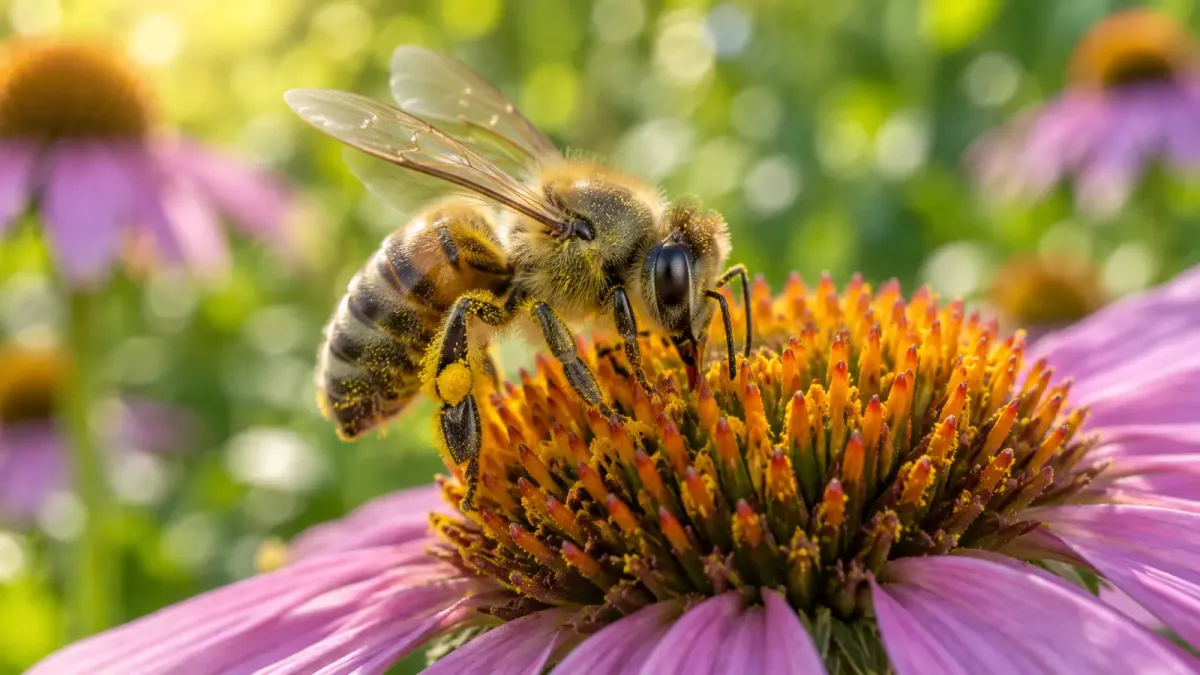
One worker honey bee is commonly credited with about 1/12 of a teaspoon of honey over her lifetime - roughly 0.6 grams. University of Missouri Extension uses the teaspoon estimate to explain the scale of a bee’s work. Treat it as an approximate contribution, not a fixed biological quota.
For a quick comparison, that makes a teaspoon about 12 worker-lifetime contributions. If you keep bees, though, do not multiply the bees you see by that fraction to decide what you can harvest. Inspect the colony’s actual stores and check the average honey yield per hive in the context of your season and location.
What Does 1/12 Teaspoon Look Like in Grams?
It is much less than a spoonful. Honey is also heavier than the same volume of water, which makes casual teaspoon-to-gram conversions easy to get wrong.
West Virginia University Extension gives an approximate honey weight of 12 pounds per U.S. gallon. That works out to about 7 grams per U.S. teaspoon. Using that rounded figure:
7 grams ÷ 12 = about 0.58 grams, which is reasonably expressed as roughly 0.6 grams.
These are household-scale estimates. Honey density varies, and a kitchen spoon is not necessarily a level measuring teaspoon. Reporting a bee’s lifetime output to several decimal places would suggest precision the original estimate does not have.
| Amount of honey | Approximate honey weight | Worker-lifetime contributions using the estimate |
|---|---|---|
| 1/12 U.S. teaspoon | 0.6 g | 1 |
| 1 U.S. teaspoon | 7 g | 12 |
| 1 U.S. tablespoon | 21 g | 36 |
| A 12-ounce jar, by net weight | 340 g | About 580 |
| A 1-pound jar, by net weight | 454 g | About 780 |
For weighed, extracted honey, use the honey jar calculator to find full jars and leftovers.
The last column is our arithmetic using 7 grams per teaspoon and the 1/12-teaspoon estimate. It is not a count of identifiable bees that worked on a particular jar. “Twelve ounces” here means the honey’s weight, not 12 fluid ounces of container volume.
A Worker Does More Than Collect Nectar
A bee on a flower is the visible part of a much bigger operation. Workers also care for brood, maintain the nest, and handle food inside it. Not every worker is a forager at the same time.
The familiar six-week lifespan refers to summer workers, not all workers in every season. Penn State Extension’s seasonal management guide contrasts summer workers with winter workers that can live up to six months. Longer life does not mean six months of continuous nectar collection: winter survival is a different job.
That is why dividing 1/12 teaspoon by 42 days does not give a useful daily production target. It spreads a rough lifetime figure across days spent on different tasks, including days when weather prevents flight.
From flower nectar to capped honey
NC State’s explanation of honey making describes work shared between foragers and bees processing nectar inside the hive:
- Collection: A forager takes up nectar and carries it in her crop, often called the honey stomach.
- Transfer and processing: Other workers receive nectar. Enzymes, including invertase, help split sucrose into glucose and fructose.
- Water removal: Evaporation concentrates the nectar; wing fanning helps move air around the comb.
- Storage: Workers seal ripened honey in wax cells.
A nectar load is therefore not the same weight as its eventual contribution of finished honey. Water leaves during ripening, and several bees may handle the material. Saying one bee “makes” a certain amount is shorthand for her part in that shared work.
What About Two Million Flowers and 55,000 Miles?
You may have seen the claim that a pound of honey represents two million flower visits and 55,000 flight miles. Missouri Extension includes those figures in its educational overview. They convey the scale of foraging, but they are not a route log for your jar.
Flower visits are not interchangeable units: plants differ in the nectar they offer, and a productive tree close to a hive presents a different trip from scattered flowers farther away. Use those numbers as broad illustrations, not exact claims on a label or a way to estimate how many flowers your balcony must supply.
For a garden project, a more useful next step is to note which weeks have few blooms and choose suitable plants to fill those gaps. Our seasonal flowers for city bees guide provides a starting point.
Safety alert: Watch visiting bees without catching them, handling them, or blocking a hive entrance for a closer look. A nectar-collecting bee is not an invitation to open a colony without protective equipment and beekeeping instruction.
Why Bee Count Cannot Predict Your Harvest
A colony changes through the season: workers emerge, take on different tasks, and die while new generations replace them. Its honey is also food for the colony, not simply inventory waiting for a beekeeper.
For planning, keep three quantities separate:
- Nectar arriving: Includes water that will leave during ripening.
- Honey in the hive: Includes stores the bees need to keep.
- Harvestable surplus: The portion you can remove after assessing current and upcoming colony needs.
A busy entrance cannot tell you all three. Nor does a tall stack of boxes establish that the upper frames contain ripe, surplus honey. Before removing anything, follow how to harvest honey from supers and ask a local mentor to help assess reserves if you are unsure.
When the honey is actually extracted and weighed, use our jars-per-hive conversion tables to plan containers. That calculation has a measurable starting point.
Legal alert: A bee-production fact does not establish a honey label’s accuracy or permission to sell food. Check applicable sales requirements and the FDA’s honey-labeling guidance before printing labels. Our guide to pricing and selling backyard honey covers the practical questions to ask.
Frequently Asked Questions
How much honey does one bee produce in its lifetime?
A commonly cited estimate is about 1/12 of a teaspoon, or roughly 0.6 grams, per worker honey bee. It illustrates a worker’s contribution to colony production, not a fixed amount that every individual makes.
How many bees does it take to make a teaspoon of honey?
Using the 1/12-teaspoon estimate, one teaspoon represents about 12 worker-lifetime contributions. That is a scale comparison, not a claim that exactly 12 bees independently made the spoonful.
How many bees does it take to make a pound of honey?
Using about 7 grams per teaspoon and 1/12 teaspoon per worker lifetime, a pound of honey represents roughly 780 worker-lifetime contributions. The starting values are approximate, so this is not an exact bee count.
Do queen bees and drones make honey?
Workers collect nectar and process it into honey. The queen’s main role is laying eggs, while drones are males whose reproductive role is mating with queens; neither does the workers’ nectar-collecting and honey-processing work.