How Many Jars of Honey Per Hive? Counts & Calculator
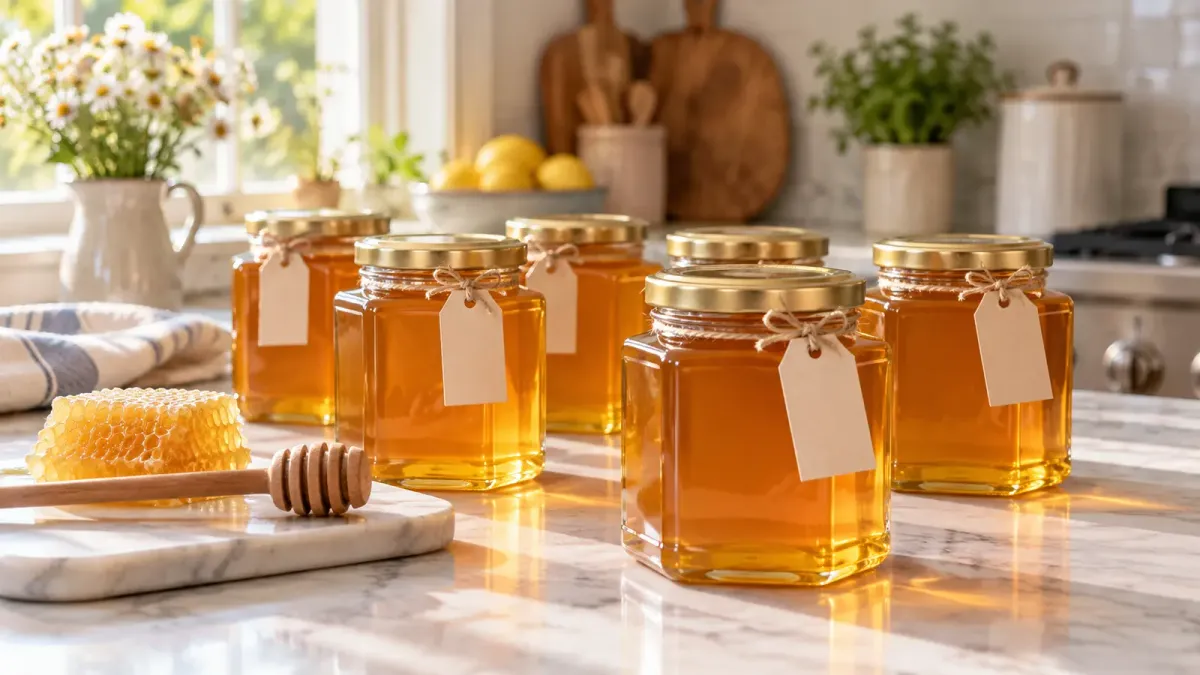
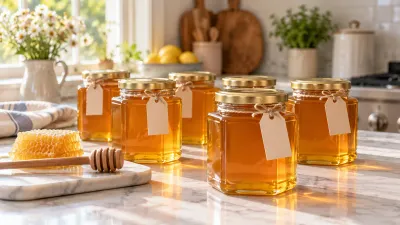
If one hive gives you 30 pounds of honey ready to bottle, you can fill 40 twelve-ounce jars or 30 one-pound jars, before filling losses. There is no fixed number of jars per hive: the answer depends on the harvestable surplus and the net weight you put in each jar. A first-year colony or a poor season may leave you with none.
Weigh your strained honey without its bucket, then calculate full jars = honey weight in pounds × 16 ÷ jar fill weight in ounces, rounding down. Use ounces of honey by weight, not fluid ounces of container capacity. To test custom batch weights and calculate unallocated leftovers, use our interactive honey jar calculator. For the seasonal expectations behind that starting weight, see how much honey does a beehive produce.
Honey-to-Jar Conversion Table
The same batch can look generous in small gift jars and modest in large family jars. Choose the fill weight before ordering containers or promising honey to anyone.
| Honey ready to bottle | Full 8-oz jars | Full 12-oz jars | Full 1-lb jars |
|---|---|---|---|
| 0 lb | 0 | 0 | 0 |
| 10 lb | 20 | 13, with 4 oz left | 10 |
| 20 lb | 40 | 26, with 8 oz left | 20 |
| 30 lb | 60 | 40 | 30 |
| 40 lb | 80 | 53, with 4 oz left | 40 |
| 60 lb | 120 | 80 | 60 |
| 80 lb | 160 | 106, with 8 oz left | 80 |
All jar sizes in this table are net honey weights. The counts assume exact fills and no honey left on equipment. They are conversions, not annual yield forecasts.
A worked example: a 40-pound batch
Forty pounds gives you 640 ounces. Divide by 12 and you get 53 full jars, with 4 ounces remaining. Rounding up to 54 would require another 8 ounces of honey.
If you first set aside two one-pound jars for your kitchen, you have 38 pounds left. That fills 50 twelve-ounce jars with 8 ounces remaining, before losses. Gifts, tasting samples, and household honey all need to come out of the same batch.
How Much Honey Is in a Super?
A super is an additional hive box used for honey storage. Its dimensions set the available space, not the amount of honey you are guaranteed to extract.
West Virginia University Extension notes that a full medium super can hold nearly three gallons of honey. At its approximate conversion of 12 pounds per gallon, that suggests around 36 pounds of honey. Partly filled frames and honey remaining in comb change what reaches the bottling bucket.
The following are illustrative batch-weight scenarios, not standardized capacity ratings or promised yields. Use them to understand the conversion; replace the assumed weight with your own measurement.
| Box scenario | Assumed extracted honey for this example | Full 12-oz jars before filling losses | Full 1-lb jars |
|---|---|---|---|
| 10-frame shallow | 20–25 lb | 26–33 | 20–25 |
| 8-frame medium | 24–28 lb | 32–37 | 24–28 |
| 10-frame medium | 30–35 lb | 40–46 | 30–35 |
| 10-frame deep used as a honey super | 50–60 lb | 66–80 | 50–60 |
Range endpoints are calculated separately and rounded down. For example, 35 pounds fills 46 twelve-ounce jars with 8 ounces left over. It does not fill just 35 twelve-ounce jars; that is the count for one-pound jars.
An eight-frame box has 20% fewer frame positions than a ten-frame box of the same depth. With equally filled, comparable frames, that means less honey in that box - not a guaranteed 20% reduction in the colony’s annual crop. Colonies can use multiple supers. If you are choosing equipment, start by comparing 8-frame vs 10-frame hive bodies.
Safety alert: A full box includes the weight of wood, frames, wax, and honey. Do not treat an extracted-honey estimate as a safe lifting limit. Arrange help or move frames in a covered food-safe carrier if you cannot lift the box comfortably; keep your route clear before opening the hive.
Do not count brood-box stores as a harvest
“Deep” describes box depth, not permission to take its contents. A deep box may be the colony’s brood chamber and essential food reserve. Likewise, honey above the brood nest is not automatically surplus.
Assess what the colony needs through the next nectar shortage and winter with local guidance. Then use the step-by-step honey harvesting guide to select and remove suitable frames. Jar arithmetic comes after that decision.
Gallons of Honey: Useful for Buckets, Not Labels
Using the approximate 12 pounds per U.S. gallon conversion:
- 1 gallon: about 12 pounds, or 16 twelve-ounce jars.
- 2 gallons: about 24 pounds, or 32 twelve-ounce jars.
- 5 gallons: about 60 pounds, or 80 twelve-ounce jars.
These assume that amount of honey, not merely a bucket bearing that capacity. A partially filled five-gallon bucket obviously contains less, and honey density varies. An Imperial gallon is a different volume; the examples here use U.S. gallons throughout.
A container supplier’s “12 oz jar” may describe fluid capacity or a nominal honey fill weight. Check which one the listing means. Fill and weigh a sample before buying a large batch of unfamiliar jars.
Get a Usable Bottling Weight
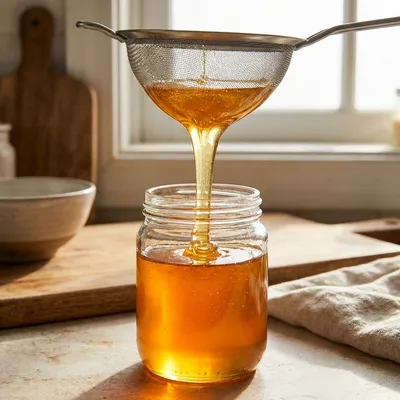
The most useful number is the net honey in the bottling bucket after straining, not the weight of supers brought indoors.
- Record the empty container’s weight. Include whatever lid or fittings will also be on it when you weigh the honey.
- Weigh the filled container. Use a scale with enough capacity for the complete load.
- Subtract the empty-container weight. That gives you the net honey weight.
- Deduct planned household use and samples. Convert the remainder into jars of your chosen fill weight.
- Check fills on a scale. Honey remaining in the gate, on utensils, or in the bucket can reduce the final count. Overfilling every jar also uses more than the table assumes.
For example, a bucket weighing 43 pounds with a matching empty weight of 3 pounds contains 40 pounds of honey. Record that batch weight and the final filled-jar count; next season, your own records will give you a better allowance for handling losses than an arbitrary percentage.
Cornell Cooperative Extension’s honey-packing guide recommends weighing filled jars to check the honey quantity after subtracting the container weight. Its practical packing advice also emphasizes clean, food-grade equipment and completely dried containers.
Food-safety alert: Keep pets and insects out of the packing area, use clean food-grade containers, and check honey moisture with a suitable calibrated refractometer before bottling. Do not add water to reach a target jar count; excess moisture increases fermentation risk. See Cornell’s packing and moisture guidance.
What Should You Expect in the First Year?
Budget for the possibility of zero jars. A new colony may need all its resources for comb, brood, and food reserves. That is a sound reason to leave honey in place, not evidence that the hive has failed.
Zero is not a universal first-year rule, either. Penn State Extension notes that nucleus colonies can produce a first-year crop during a strong nectar flow. Actual colony condition matters more than its birthday.
In a city, look beyond the flowers in your own yard. Nearby nectar-producing trees, gaps between blooms, weather during flowering, and competing colonies affect what is available. Keep notes on when your supers gain weight; do not assume that an irrigated neighborhood guarantees an 80-pound harvest.
Legal alert: Before selling, confirm your state’s honey-processing or cottage-food rules and the requirements for your sales channel. Check current labeling requirements, including net quantity; exclude the jar and lid from the honey’s weight. The FDA’s honey-labeling guidance is a starting point, not a permit or a complete state-law checklist.
Frequently Asked Questions
How many jars of honey does one hive produce?
There is no fixed jar count. If a hive provides 30 pounds of honey ready to bottle, that fills 40 jars at 12 ounces net weight each, or 30 one-pound jars, before filling losses. A colony with no harvestable surplus provides no jars.
How many 12-ounce jars can I fill with 40 pounds of honey?
Forty pounds equals 640 ounces by weight. At 12 ounces per jar, that fills 53 jars with 4 ounces left over, assuming no filling losses or overfill.
How many pounds of honey are in a gallon?
A U.S. gallon of honey weighs approximately 12 pounds, although density varies. That is roughly 16 jars filled to 12 ounces net weight. Weigh the actual honey for bottling and labeling rather than relying on volume.
Can I expect jars of honey from a first-year hive?
Plan for the possibility of none. A new colony needs to build its nest and food reserves. Some strong colonies can produce a first-year surplus in a good nectar flow, but colony needs and actual stores must determine the harvest.