American Foulbrood Testing: Signs, Samples & Next Steps
American foulbrood testing starts with suspicious brood, not a smell test. Sunken, perforated cappings, brown larval remains, or tightly attached dark scales warrant a call to your apiary inspector. Stop moving frames and sharing equipment while you arrange an assessment. A rope test can strengthen suspicion; it cannot replace laboratory confirmation.
American foulbrood, or AFB, is caused by Paenibacillus larvae. Pennsylvania’s AFB guidance distinguishes its danger to bees from human consumption of honey. The disease is not a human infection risk; the immediate concern is spreading spores to other colonies. Keep suspect honey out of bee feed and hold it separately pending handling advice; this is not blanket clearance to extract or sell it.
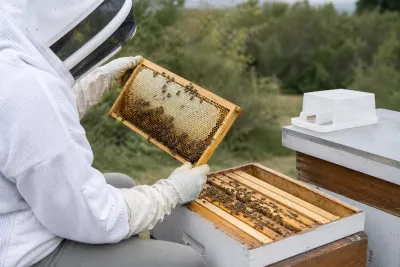
The hero is an AI-generated inspection illustration, not a photograph of confirmed AFB or a diagnostic test result.
What Does American Foulbrood Look Like?
Look at the contents of affected cells as well as the pattern across the frame. One empty cell, a chewed capping, or a patchy brood nest cannot tell the whole story.
| What you inspect | Healthy brood commonly shows | Signs that deserve an AFB assessment |
|---|---|---|
| Open larvae | Plump, pearly-white larvae curled into a C shape | Discolored, collapsed remains rather than distinct, plump larvae |
| Worker brood cappings | Intact, slightly convex caps | Sunken, dark or greasy-looking caps, sometimes punctured |
| Dead brood consistency | No decomposing remains | Brown, sticky material that may stretch into a thread |
| Dried material in cells | No adherent diseased-brood scales | Dark, brittle scales stuck to the lower cell wall |
| Pattern across the comb | A reasonably continuous patch appropriate to brood age | A mixture of capped, empty, and diseased cells |
The healthy-larva comparison and overlap with other diseases are described in UF/IFAS’s foulbrood identification guide. NC State Extension’s disease guide describes AFB’s discolored sealed brood and persistent scales. Comb age affects wax color, and brood patterns change as bees emerge, so dark wax or gaps alone are not a diagnosis.
AFB often becomes visible in older, sealed larvae or young pupae. European foulbrood more often affects younger, open larvae, although appearances overlap. Read the differences between American and European foulbrood before assigning a disease name from one frame.
The Matchstick Rope Test: What It Can Tell You
The test checks whether decomposing brood stretches into a sticky thread. If your inspector recommends performing it, ask how to retain the probe and prevent cross-contamination before starting.
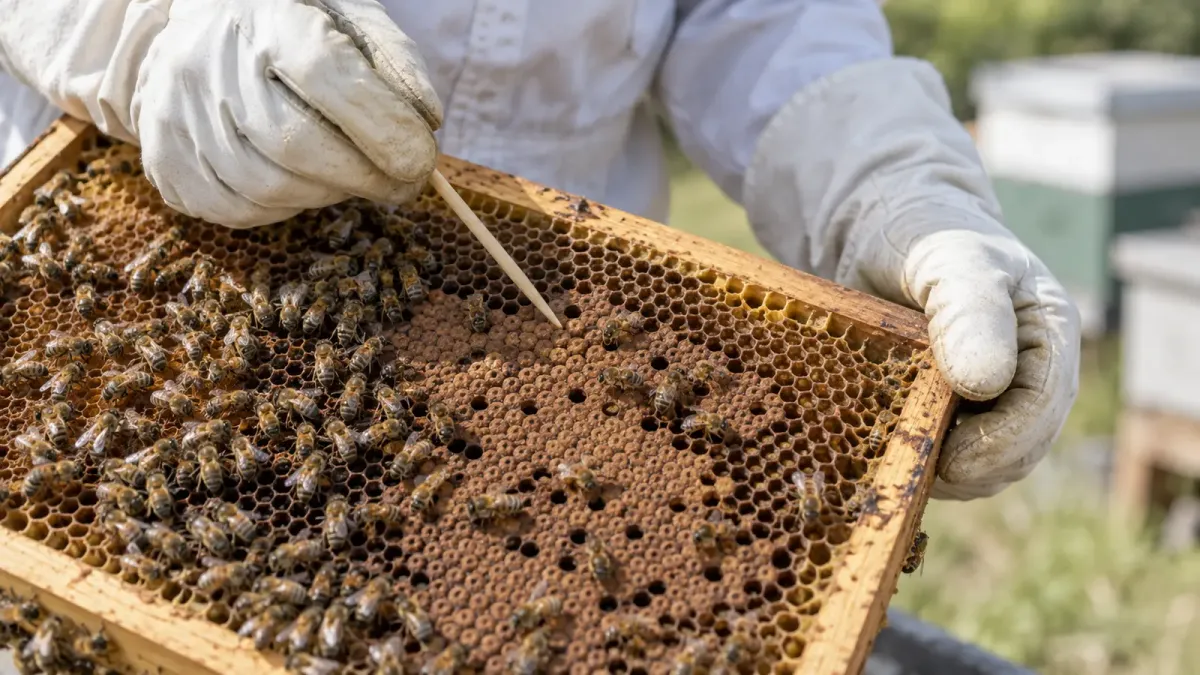
- Choose an affected cell. Use a clean, disposable wooden probe to reach suspect discolored remains, not a healthy larva chosen at random.
- Gently stir the remains. Keep the frame over its own hive and avoid smearing material onto nearby equipment.
- Withdraw slowly. Note whether a brown thread forms. Record the cell location and result, then retain or dispose of the probe as instructed. Never reuse it in another colony.
UF/IFAS illustrates ropiness with a thread roughly an inch long. Treat that as a field example, not a universal pass/fail ruler. A positive result needs follow-up, and the FDA notes that infected remains can be watery and produce a negative result.
Safety and biosecurity alert: Wear a veil and suitable protective clothing. Keep suspect tools and gloves apart from clean equipment, and stop before opening another colony. Ask the inspector about decontamination; a quick wipe, freezing, or an ordinary household wash is not clearance to reuse suspect equipment.
Scales and the Holst Milk Test
Old AFB remains can dry into hard, dark scales that cling to the lower cell wall. Their position can make them easy to overlook. Do not scrape an entire frame clean while trying to decide what you have; leave material available for sampling.
The Holst milk test checks whether enzymes associated with infected brood or scales break down milk proteins. A sample tube becomes clearer than a separate control tube. Michigan State University’s illustrated protocol includes real brood photographs and explains the temperature and control requirements.
Technique matters. Early-stage infected larvae can give false negatives; pollen can interfere and give a false positive. This is an inspector-assisted field option, not a substitute for submitting an appropriate sample. Use dedicated test supplies, not utensils that will return to food preparation.
Field Suspicion Versus Laboratory Confirmation
The USDA APHIS case definition makes a useful distinction:
- Suspect: Signs and history fit AFB.
- Presumptive positive: A suspect case also has a positive field test, such as ropiness or a lateral-flow test.
- Confirmed positive: Compatible clinical signs accompany laboratory identification of P. larvae by culture and/or PCR.
You do not need a confirmed result before asking for help. Conversely, finding spores in a sample without considering colony signs is not the same thing as establishing clinical disease. Let the inspector and laboratory interpret the result together.
Sending Brood Comb to the USDA Bee Research Laboratory
After agreeing collection with your inspector, follow the USDA-ARS Beltsville submission instructions, checked September 16, 2026:
- Select at least 2 × 2 inches of comb with dead or discolored brood, without honey.
- Loosely wrap in paper or use a paper bag, inside a sturdy cardboard box.
- Avoid plastic, foil, waxed paper, tins, and glass for brood comb.
- Include contact details, a short problem description, and the colony ID.
Use the current mailing address on that page. Its separate adult-bee alcohol-preservation instructions do not apply to brood comb.
Reporting, Quarantine, and Equipment Decisions
Outside the U.S., follow the local authority’s disease process: UK bee-health reporting and New Zealand’s AFB registration, inspection and destruction rules differ. Do not apply the USDA submission procedure or a U.S. equipment decision to another country without its authority’s instructions.
Start with your state apiary program or agriculture department. Our guide to finding mandatory state apiary reporting contacts explains how to locate the responsible authority; reporting duties and response procedures depend on your jurisdiction.
Legal alert: Promptly ask the authority about reporting, sampling, and movement restrictions. Do not wait for a mail-in result before making contact, move a suspect hive to another property, or destroy evidence on your own. Follow any quarantine order and obtain instructions before shipping samples.
There is no single disposal rule for every reader. For example, Pennsylvania’s apiary program describes quarantine and treatment orders when AFB is detected. Elsewhere, approved options and required actions can differ. Ask whether destruction, professional irradiation of equipment, or another authorized approach applies; none is a do-it-yourself shortcut. Michigan State’s AFB guide discusses commercial irradiation, but local authorization and service availability still need checking.
Antibiotics also are not a way to sterilize comb. The FDA explains that they do not kill AFB spores, and their use requires veterinary oversight. Medication decisions must fit both the product label and the inspector’s disease-control requirements.
What to Do While You Wait
Keep a short record: hive ID, dates, photographs, recent treatments, and any frames or tools shared with other colonies. Tell the inspector about those connections rather than trying to trace the problem from memory later.
Do not combine colonies, lend suspect equipment, or run suspect honey through a shared extractor. Keep exposed comb away from robbing bees. Ask how to protect a weak colony without sealing live bees inside or compromising ventilation.
Once the immediate concern is resolved, build those notes into your routine urban apiary health inspections. A clear record of what changed is more useful than repeatedly opening the same cells to see whether they rope.
Frequently Asked Questions
How do you test for American foulbrood?
Contact your apiary inspector when brood looks suspicious. Field tests can support the assessment, but laboratory identification of Paenibacillus larvae alongside clinical signs establishes confirmation under the USDA APHIS case definition. Ask which sample the receiving laboratory needs before cutting comb.
Does a negative rope test rule out American foulbrood?
No. Some infected remains are watery rather than ropy. Keep suspicious brood under assessment even when no thread forms; a negative field test is not permission to reuse or share the colony’s equipment.
Is American foulbrood harmful to humans?
AFB is a bee brood disease, not a human infection risk. That does not establish that a particular honey batch is fit for sale or free of medication residues. Keep suspect honey separate, never feed it to bees, and ask the inspector how to handle it.
Is USDA American foulbrood testing free?
USDA-ARS lists free bee disease diagnosis for US and territory submissions. Check current instructions before shipping; postage is not included.