UK Beekeeping Laws: Garden Rules, Licences & DEFRA
By UrbanBee Editorial TeamSources checked Oct 14, 2026
⚠️ Not Legal Advice: Summaries for educational purposes only. Verify with official United Kingdom authorities.
You can usually keep honey bees in a UK garden without a general beekeeping licence, provided you have the right to use the site and comply with local restrictions, nuisance law and bee-health duties. BeeBase registration is voluntary; reporting suspected notifiable diseases is a separate legal obligation. Rules and responsible authorities differ across England, Wales, Scotland and Northern Ireland.
Before ordering bees, check your lease or title restrictions, ask the council about unresolved placement questions, and register through the appropriate bee-health service. For a London address, use our London borough and rooftop guide alongside this national overview.
UK garden beekeeping requirements at a glance
| Question | Practical answer | What to check before installation |
|---|---|---|
| General licence | No general hobby beekeeping licence | Separate land-use, building and site permissions |
| Registration and fees | BeeBase is voluntary; Northern Ireland uses DataBees | Current registration service for your nation |
| Council or landlord permission | Depends on the property and use | Lease, covenants, allotment agreement and local restrictions |
| Maximum hives | No single UK-wide residential allowance | Space, forage, safe management and site conditions |
| Boundary setback | No universal garden distance | Flight paths, nearby doors, paths and occupied areas |
Registration is a way to make disease alerts and inspections easier. It does not certify that your garden, balcony or roof is suitable.
BeeBase, DEFRA and the four UK nations
The DEFRA and APHA guidance directs beekeepers in England, Scotland and Wales to BeeBase, and those in Northern Ireland to DataBees. Keep your contact details and apiary locations accurate so the relevant service can reach you.
The National Bee Unit delivers bee-health work in England and Wales; Scotland and Northern Ireland have their own responsible teams and legal arrangements. The Bee Diseases and Pests Control Order 2006 is part of the English framework, not a reason to assume that every UK nation has identical legislation. Use the nation-specific contacts and movement guidance when buying bees from elsewhere.
Garden placement and council nuisance complaints
A garden hive should not force neighbors to walk through its entrance traffic. Locate it away from shared paths, frequently opened windows, washing areas and children’s play spaces. Provide a reliable water source before bees arrive, and leave enough working space for an inspection without entering another person’s land.
Consider erecting a 2-metre flyway barrier where the departure route crosses occupied space. That height is a practical design option; it is not a universal statutory requirement or a BBKA rule that automatically approves a boundary placement.
Councils investigate complaints against the applicable nuisance framework. Sections 79 and 80 of the Environmental Protection Act provide a route for dealing with qualifying statutory nuisance, including animals kept in a manner that causes nuisance or harms health. An abatement notice can require action where the legal test is met. A person disliking bees does not, by itself, establish that test.
Start resolving neighbor disputes before statutory nuisance complaints by recording the problem, reviewing flight paths and arranging experienced help for defensive behavior. Private land managers can also restrict hives through their agreements.
Allotment beekeeping requires a site agreement
Section 12 of the Allotments Act 1950 addresses hens and rabbits and applies in England and Wales. It does not grant an automatic entitlement to keep honey bees.
Ask the landlord, parish council or allotment association for written permission covering hive numbers, location, inspections, insurance, swarm response and what happens if the colony must be removed. An operator may require association membership or a specified public-liability policy. Check the current insurance schedule and exclusions rather than assuming a membership benefit meets every site’s terms.
Report notifiable bee diseases and unusual pests
Suspected American foulbrood, European foulbrood, small hive beetle and Tropilaelaps mites require urgent contact with the relevant bee-health authority. Report yellow-legged Asian hornet sightings through the current official reporting route, ideally with a photograph taken from a safe distance. Do not disturb a suspected hornet nest.
Our guide to identifying notifiable foulbrood diseases explains warning signs. A photograph, smell or home test cannot clear a suspect colony. Stop transferring bees, comb and used equipment while you obtain instructions; do not attempt destruction or treatment without the authority’s direction.
A workable first-hive plan
- Confirm site permission and any council conditions in writing.
- Take a beginner course and arrange someone to cover inspections when you are away.
- Plan water, flight screening, working clearance and seasonal swarm management.
- Register the location with the appropriate bee-health service.
- Save the relevant disease contacts and check movement rules before acquiring bees.
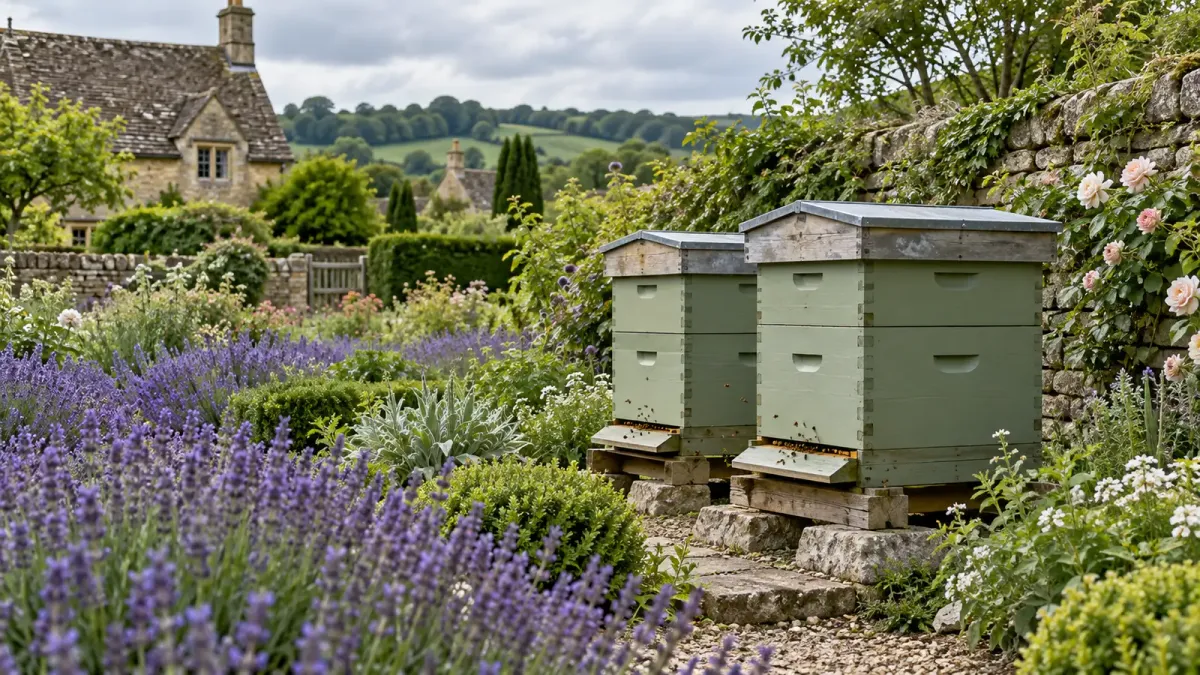
The hero is an AI-generated illustration of a garden apiary; it does not show an inspected or approved site.
Nation-specific registration and movement guides
For a site in Scotland, use the Scottish bee-health authority and reporting guidance. The Wales guide explains Welsh legislation and BeeBase records, while Northern Ireland uses DataBees and a distinct import or export framework. For local property questions in the capital, use the existing London guide.
Frequently asked questions
Do you need a licence to keep bees in the UK?
There is no general hobby beekeeping licence. You still need permission to use the site, must meet applicable local and property rules, and must comply with bee-health reporting and movement requirements.
Is BeeBase registration compulsory?
BeeBase registration is voluntary and encouraged for beekeepers in England, Scotland and Wales. Northern Ireland uses DataBees. Registration does not replace mandatory disease reporting.
Can I keep honey bees on an allotment?
Ask the allotment landlord or operator for written permission and its conditions. Section 12 of the Allotments Act 1950 concerns hens and rabbits, not an automatic right to keep bees.
How far must a garden hive be from the boundary?
There is no single UK-wide garden setback. Check site conditions, local restrictions and nuisance risks. A flyway screen can help manage traffic but does not guarantee that a location is lawful.