London Beekeeping Rules: Borough Laws & Rooftops
By UrbanBee Editorial TeamSources checked Oct 14, 2026
⚠️ Not Legal Advice: Summaries for educational purposes only. Verify with official London authorities.
You can keep honey bees in London where the property, local restrictions and hive management allow it. There is no blanket rooftop or garden approval for Greater London. Building permission, nuisance risks and adequate forage matter as much as the absence of a general beekeeping licence.
Identify your borough, secure written permission for the proposed site, and ask a local association to assess it before buying bees. Read the UK national beekeeping and DEFRA laws for registration and disease duties that also apply in London.
London beekeeping rules and site choices
| Requirement | Garden or allotment | Roof or terrace |
|---|---|---|
| Bee-health registration | Voluntary BeeBase registration encouraged | Same bee-health framework |
| General licence and fee | No general hobby licence; site charges may apply | Building or site approval may carry costs |
| Permission | Check ownership, lease and allotment conditions | Owner/freeholder and relevant building approvals |
| Hive numbers | Site conditions and local restrictions; no universal London limit | Assess forage and approved roof capacity |
| Setbacks and screening | Prevent low flights through occupied space | Wind exposure, safe edges and clear escape routes |
A borough’s role, a landlord’s approval and a bee inspector’s role address different questions. Keep a written record of each answer.
Forage pressure in central London
The London Beekeepers’ Association’s London bee assessment describes uneven forage and colony density, with particular concern about central London and other heavily stocked areas. Its position documents were marked as under review in April 2026. They are association guidance, not statutory borough hive quotas.
A postcode in Camden, Westminster, Hackney or Islington does not tell you how many colonies the surrounding flowers can support. A few roof planters also cannot establish the carrying capacity of a neighborhood. Ask about nearby apiaries, seasonal flowering gaps and realistic inspection access before proposing additional colonies.
If your aim is helping wildlife, planting and maintaining diverse flowers can be a useful first project. Honey bee installation should follow a site assessment rather than serve as an automatic biodiversity measure.
Borough nuisance enforcement and neighbor concerns
Shared courtyards, narrow passages and closely spaced windows make placement especially sensitive. Yellow or brown spotting on washing, cars and skylights can prompt complaints, as can repeated low flights or defensive bees near a doorway.
Environmental health must assess the facts against the applicable legal nuisance test. The government’s nuisance guidance explains council investigation and abatement notices. Swarming alone does not automatically prove an offence, but repeated preventable problems call for prompt management.
Record where the problem occurs, inspect the departure route and adjust the site with experienced support. A fence may lift flight traffic; water supplied at the apiary can reduce visits to other gardens. If an official notice arrives, follow its deadline and obtain advice about the specific conditions.
Rooftop and terrace beekeeping in London
LBKA’s siting guidance discourages high rooftop sites because of wind, the energy cost of reaching the roof and potential vibration from equipment. A prestigious address or existing green roof does not settle those concerns.
For a proposed roof site, obtain agreement on:
- Structural review of wet hive weight, stands, people and stored equipment.
- Safe access, edge protection and a clear route for carrying boxes.
- Fire restrictions and smoker handling.
- Separation from air intakes, mechanical plant and routine maintenance work.
- Inspection scheduling, emergency access and responsibility for removal.
A parapet needs to be assessed as part of the roof’s safety arrangements; it is not a universal hive setback exemption. Use our urban rooftop apiary logistics and wind management guide for planning questions, with building professionals resolving structural and access requirements.
Swarm management in dense neighborhoods
Arrange inspection cover before spring, keep an experienced contact available and have a practical plan for a colony that outgrows its equipment. Our high-density urban swarm prevention guide helps organize those decisions.
For an accessible swarm, contact a local association’s current collection service. Keep people away while arrangements are made. A collector may decline dangerous roof, height or wall access; an established colony inside a building needs a different assessment.
Update BeeBase when your apiary changes and report suspected notifiable bee disease through the NBU. Registering the roof does not authorize access to it or settle a neighbor dispute.
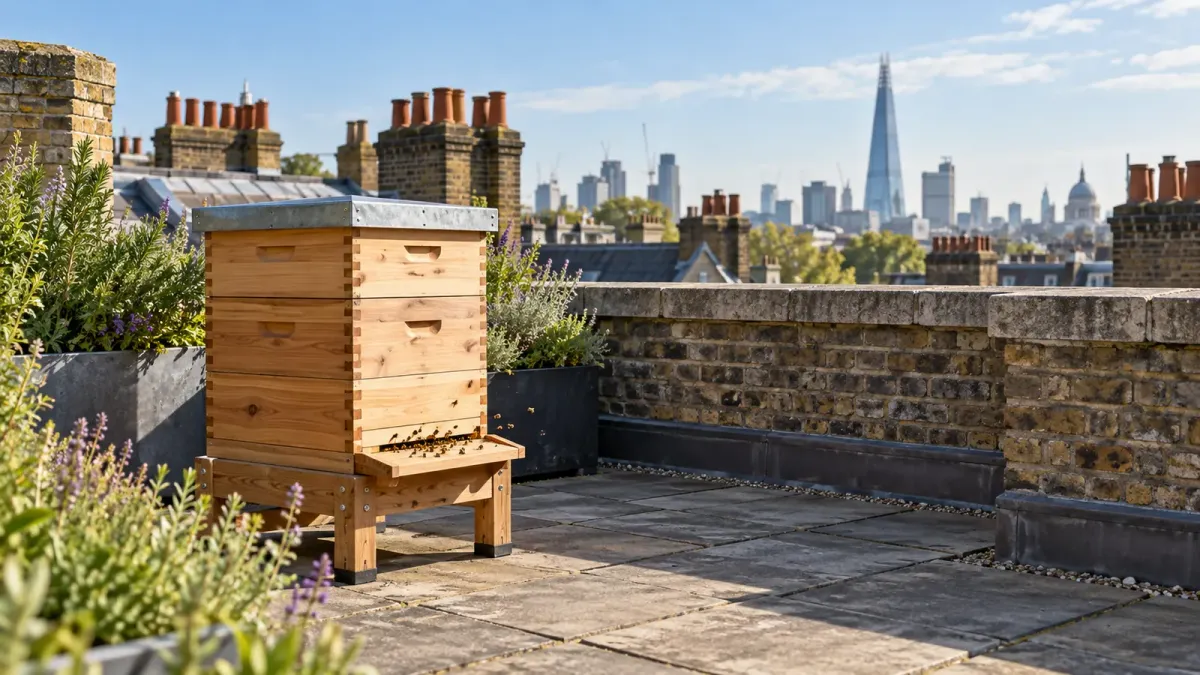
The hero is an AI-generated London rooftop illustration, not evidence that the pictured arrangement is approved.
Frequently asked questions
Can you keep bees in London?
Often yes, but suitability depends on the address, property permission, local restrictions, nuisance risks and available forage. There is no London-wide approval that makes every garden or roof suitable.
Are rooftop beehives automatically allowed in London?
No. Obtain written permission from the building owner or freeholder and review structural capacity, access, edge protection, fire procedures and insurance. LBKA discourages high rooftop sites because of wind and other practical problems.
Does London have a single legal hive-density limit?
The sources reviewed do not establish one numerical limit for all London properties. LBKA’s concerns about hive density are ecological guidance, while local agreements or approvals may impose specific limits.
Who handles a complaint about garden bees?
Contact the relevant borough’s environmental health team. Bee disease concerns go to the National Bee Unit, and swarm collection can be arranged through a local beekeeping association.