Swarm Cell vs Queen Cell: Identification & Action
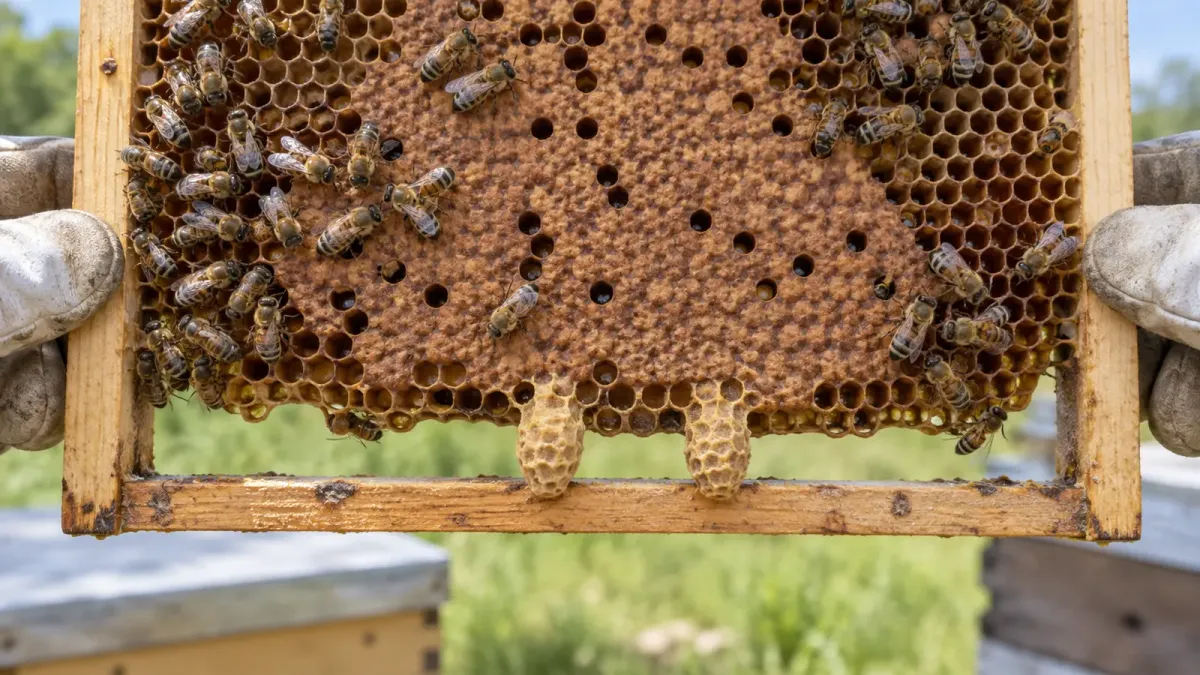
Every swarm cell is a queen cell, but not every queen cell means a hive is preparing to swarm. Colonies also raise queens to replace an existing queen through supersedure or after losing her. An empty queen cup is different again: its presence alone does not establish active queen rearing.
Before cutting anything, record whether each structure is empty, contains an egg or larva, or is capped. Check queen status, the youngest brood, population, and your last inspection notes. If the evidence is unclear, preserve the cells and get an experienced local beekeeper to help interpret the colony.
The AI-generated hero illustrates peanut-shaped queen cells near a frame’s lower edge. Their position does not prove that the colony is preparing to swarm, and the image cannot date their development.
Name the Process, Not Just the Shape
“Swarm cell” and “supersedure cell” describe why a queen is being raised. They are not reliably distinguishable wax objects in isolation.
| Situation | What the colony is doing | Supporting clues | What the clue cannot prove |
|---|---|---|---|
| Swarm preparation | Preparing for colony reproduction | Strong population, crowding, active queen cells, seasonal context | Bottom-edge cells alone do not establish swarming |
| Supersedure | Replacing an existing queen | Queen still present; concerns about performance; replacement cells | A patchy brood pattern alone does not identify the cause |
| Emergency queen rearing | Responding to queen loss | Recent queen loss or manipulation; cells developed from suitable young brood | Failing to spot the queen once does not prove she is gone |
UF/IFAS’s queen-management guide explains swarming and supersedure as different reasons for queen production. Avoid judging queen quality from one uneven frame: brood pattern needs context, including colony health.
Check the Stage Before You Choose an Action
A quick look at the bottom bars is not a complete assessment. Examine brood frames carefully without damaging projecting cells.
| Structure or stage | What you may see | Sensible interpretation |
|---|---|---|
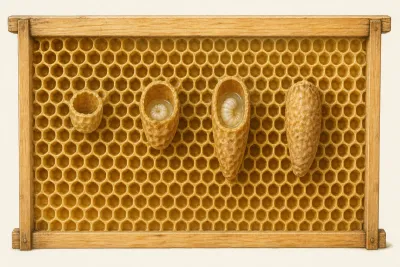
| Empty queen cup | Small rounded cup with no visible egg or larva | Record it; not proof of an imminent swarm |
| Occupied cup or open cell | Egg or larva; larva may be surrounded by royal jelly | Queen rearing needs closer assessment |
| Elongating open queen cell | Downward-projecting wax cell with developing larva | An active process, not a reliable purpose label |
| Capped queen cell | Sealed, often peanut-textured structure | Development is advanced, but discovery does not establish its age |
A cell can be difficult to see into. Write “contents not confirmed” instead of turning a poor view into an empty-cell diagnosis. Do not cut one open simply to complete the record.
UF/IFAS’s swarm-control guide cautions that queen cells may occur in different places on frames. Count and position help describe what you found; neither supplies a universal cutoff between supersedure and swarming.
The Queen’s Clock Started Before You Found the Cell
Queen development usually takes about 16 days from egg to adult, with some variation. Cells are capped at roughly day eight. Penn State’s cell-builder guide describes the developmental timetable.
Finding a capped cell on Tuesday does not mean a queen will emerge 16 days from Tuesday. Nor does it prove that the old queen will leave within a particular 24- or 48-hour window. The colony may be preparing to swarm, may already have swarmed, or may be replacing its queen for another reason.
Emergence is not the finish line. A virgin queen still needs time and suitable conditions to mature, mate, and begin laying. Weather and drone availability matter, so arrange follow-up around a locally informed plan rather than repeatedly opening the hive to look for eggs.
Four Checks Before Cutting Cells or Making a Split
1. Establish what you actually know about the queen
Record a sighting if you have one. Fresh eggs indicate recent laying, not certainty that the queen remains in the hive now. Compare with earlier notes about her presence, brood, and any recent manipulation.
2. Compare population and usable space
Was the colony crowded at the last inspection? Has the adult population fallen sharply since then? Is drawn comb available where the colony can use it? These observations support a diagnosis, but none settles it alone.
For measures taken before advanced swarm preparation, see urban swarm prevention strategies. Adding a box should not be treated as a guaranteed reset once active preparations are underway.
3. Check whether two viable colonies are realistic
A split needs more than an empty box. Assess adult bees, brood, stores, health, queen provision, and the season. A weak or unhealthy colony should not be divided merely because a queen cell is visible.
The UF/IFAS guide to using nucleus colonies explains why nuc management needs planning. For the assessment behind this decision, read how to split a hive with swarm cells; carry out a first split with a mentor.
4. Protect the replacement plan
If the colony is queenless or superseding, indiscriminate cell removal may take away its route to a new queen. If it is preparing to swarm, cutting cells without addressing the colony’s condition is not a dependable solution.
Write down the working diagnosis, the evidence still missing, and the agreed follow-up date. “Two capped cells on frame six” is more useful than “swarm fixed.”
Safety alert: Handle frames gently by their wooden parts and avoid crushing projecting cells against adjacent comb. Keep protective equipment on, minimize time with brood exposed, and close the hive if defensive behavior puts nearby people at risk.
Legal alert: Before creating another colony, check local colony limits, registration requirements, site permission, and safe placement. A temporary nuc may still count as a colony; do not assume a spare balcony is an authorized apiary.
If bees have already clustered away from the hive, keep access clear and follow what to do if bees swarm on a balcony. Do not climb or reach over an edge to recover them.
Frequently Asked Questions
What is the difference between a swarm cell and a queen cell?
Queen cell is the general term for a cell used to rear a queen. A swarm cell is a queen cell associated with colony reproduction by swarming.
Do queen cells at the bottom of a frame prove swarming?
No. Position and cell number are clues, not a diagnosis. Assess cell contents, queen status, recent brood, colony strength, and inspection history together.
Should I cut out every queen cell?
No. Removing every cell can destroy a colony’s replacement queen and does not reliably resolve swarm preparation. Establish why the colony is raising queens before intervening.
How long does a queen take to emerge?
A queen usually develops from egg to adult in about 16 days, with some variation. That clock starts at egg laying, not when you discover the cell; mating and the start of laying come later.