Best Treatment for Ants Around My Hive
Disclosure: UrbanBee is reader-supported. When you buy through links on our site, we may earn an affiliate commission at no extra cost to you. Learn more.
Disclosure: UrbanBee is reader-supported. When you buy through links on our site, we may earn an affiliate commission at no extra cost to you. Learn more.
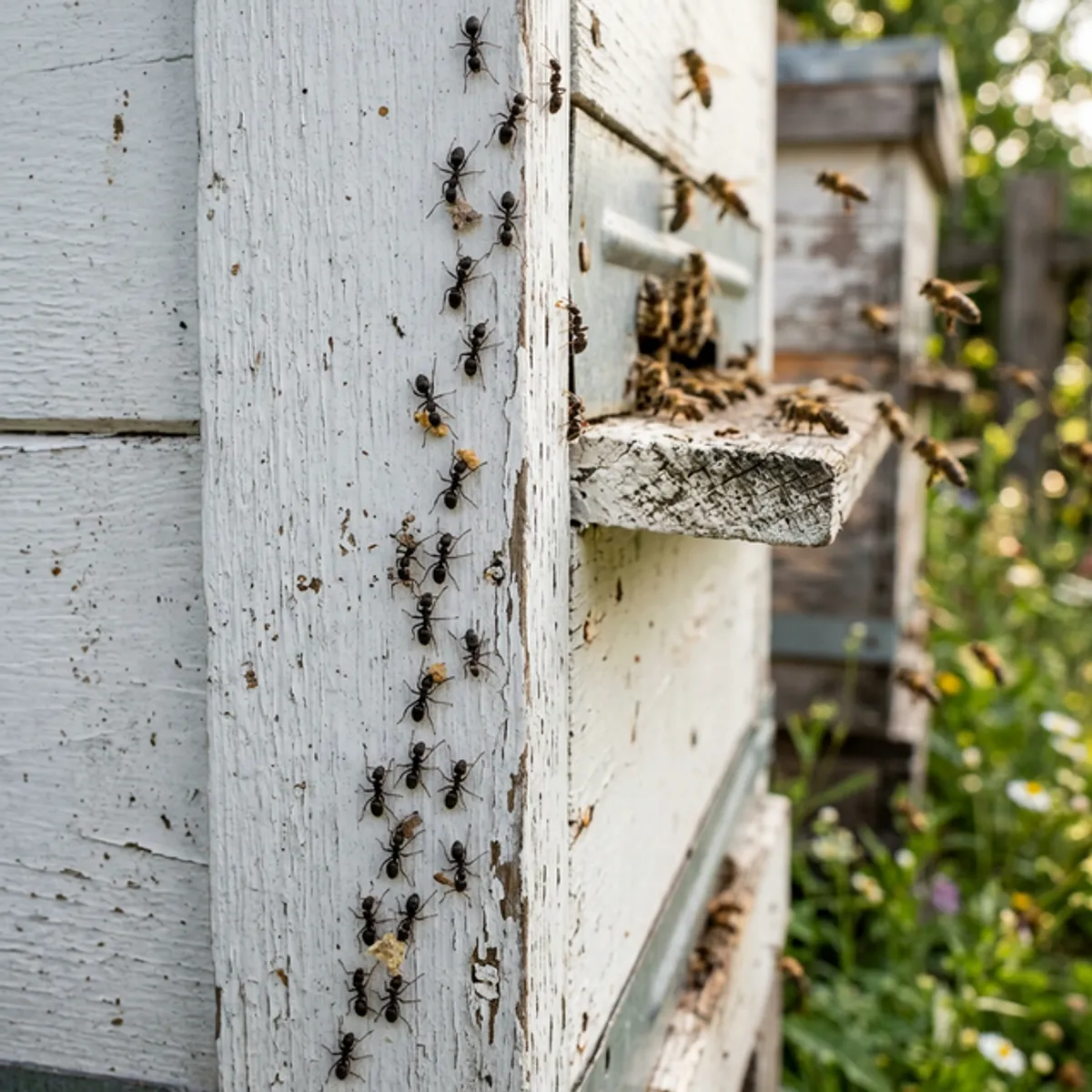
If you offer a box full of thousands of pounds of concentrated sugar to the outdoors, insects will come looking for it. Ants are the most common uninvited guests in an urban apiary.
While a few small sugar ants scurrying under the telescopic cover are nothing to worry about, a massive trail of ants streaming into the entrance can decimate a weak colony’s honey stores and stress the bees.
Because honey bees are insects, you cannot use traditional chemical ant sprays or poisoned baits near your hive. Here are the safest, most effective natural barriers to keep ants out of your beehive.
1. Eliminate the Attractant
Ants are almost always drawn to a hive because of a beekeeper’s mistake. The two biggest culprits are spilled sugar syrup and weak colonies.
- Clean up spills: If you use a Boardman entrance feeder or a leaky top feeder, the syrup drips down the front of the hive or pools on the bottom board. This is a neon “All You Can Eat” sign for ants. Switch to internal frame feeders or leak-proof inverted pails, and immediately wipe up any spills.
- Reduce the entrance: A strong colony can easily defend its entrance from ants. If ants are marching freely inside the box, your colony is either very small (like a newly installed package) or declining from Varroa mites. Install an entrance reducer immediately so the guard bees have a smaller area to defend.
2. Diatomaceous Earth (DE)
Food-grade Diatomaceous Earth is a highly effective, mechanical insecticide. It is made of fossilized, microscopic diatoms that act like thousands of tiny razor blades. When ants walk through it, the powder cuts their exoskeletons, causing them to dehydrate and die.
- How to use it: Sprinkle a heavy ring of DE on the ground completely circling the base of the hive stand.
- The Catch: DE is useless when wet. You must reapply it after a rainstorm or heavy morning dew. Never sprinkle DE on the landing board or inside the hive, as it will kill your bees too.
3. Cinnamon
Ants hate the smell and texture of ground cinnamon. It acts as a natural, bee-safe repellent.
- How to use it: If you see ants congregating under the outer telescopic cover (a very common spot where it’s warm and safe from the bees), simply sprinkle a thick layer of cheap, powdered cinnamon directly on top of the inner cover. The ants will pack up and leave within 24 hours.
4. The Moat Method (Oil or Water)
The most foolproof way to stop ants is to physically prevent them from accessing the wood.
If your hive sits on a stand with four individual legs, you can create a moat system.
- Place each leg of the hive stand inside a small metal or plastic container (like a tuna can).
- Fill the container with cheap vegetable oil or mineral oil. (Water evaporates too quickly in the summer).
- The ants will climb up the outside of the can and refuse to cross the oil.
- Important: Make sure tall grass isn’t touching the hive box, or the ants will use the grass as a bridge right over your moat!
You can also purchase commercial ant-proof hive stands that use built-in oil traps or sticky barriers.
Return to our Urban Hive Management Hub for more troubleshooting tips.