Can Bees Survive Extreme Cold on a Balcony?
Disclosure: UrbanBee is reader-supported. When you buy through links on our site, we may earn an affiliate commission at no extra cost to you. Learn more.
As the leaves drop and the first major freeze of the season hits the city, beginner urban beekeepers often panic. “My hive is sitting exposed on a 10th-floor balcony! How can thousands of tiny insects possibly survive a zero-degree blizzard out there?”
The instinct is usually to pile blankets over the hive, stuff the entrance with towels, and try to keep them “warm.”
Stop right there.
Honey bees have survived ice ages. They are masters of thermoregulation. Your well-intentioned efforts to keep them warm are exactly what will kill them. Here is how bees actually survive the cold, and why moisture management, not heating, is the key to balcony survival.
Phase 1: The Winter Cluster
Unlike wasps or bumblebees (where only the queen survives the winter underground), an entire honey bee colony survives the winter. They do not hibernate.
As the temperature drops below 57°F (14°C), the bees stop flying. They retreat deep into the hive and form a tight sphere, known as the “winter cluster.”
- The Queen: The queen and the brood are in the exact center of this ball, kept at a toasty 93°F (34°C) even if it is -20°F outside.
- The Heater Bees: The bees on the outside edge of the sphere (the “mantle”) act as insulation.
- The Engine: The bees in the center detach their flight muscles from their wings and shiver violently. This friction generates massive amounts of metabolic heat.
The entire cluster slowly moves upward over the winter, consuming the stored honey (their fuel source) above their heads. A healthy colony in a wooden box needs absolutely no help staying warm, provided they have enough honey to fuel their shivering.
Phase 2: The Real Killer (Condensation)
There is an old, hyper-accurate saying in beekeeping: “Cold doesn’t kill bees. Wet kills bees.”
Think of a beehive in winter like a tent with three people sleeping inside. As those 20,000 to 40,000 bees metabolize honey and breathe, they exhale an enormous amount of warm, moist air.
Remember your high school physics: Heat rises. When that warm, moist breath hits the freezing cold, uninsulated wooden ceiling of the hive (the inner cover), it instantly condenses into water droplets. It then “rains” ice-cold water directly down onto the winter cluster.
A dry bee can survive -30°F. A wet bee will freeze to death at 45°F.
The Fatal Mistake: Tarps and Blankets
This is why beginner beekeepers kill their hives. They wrap the entire hive in a plastic tarp or heavy blankets to block the draft. Doing this seals up all the ventilation. The moisture builds up exponentially, rains down, and kills the entire colony by January.
Phase 3: The Balcony Strategy (Insulation + Ventilation)
If your hive is on a high-rise balcony, your two biggest enemies are wind chill and condensation. Here is how to fix both:
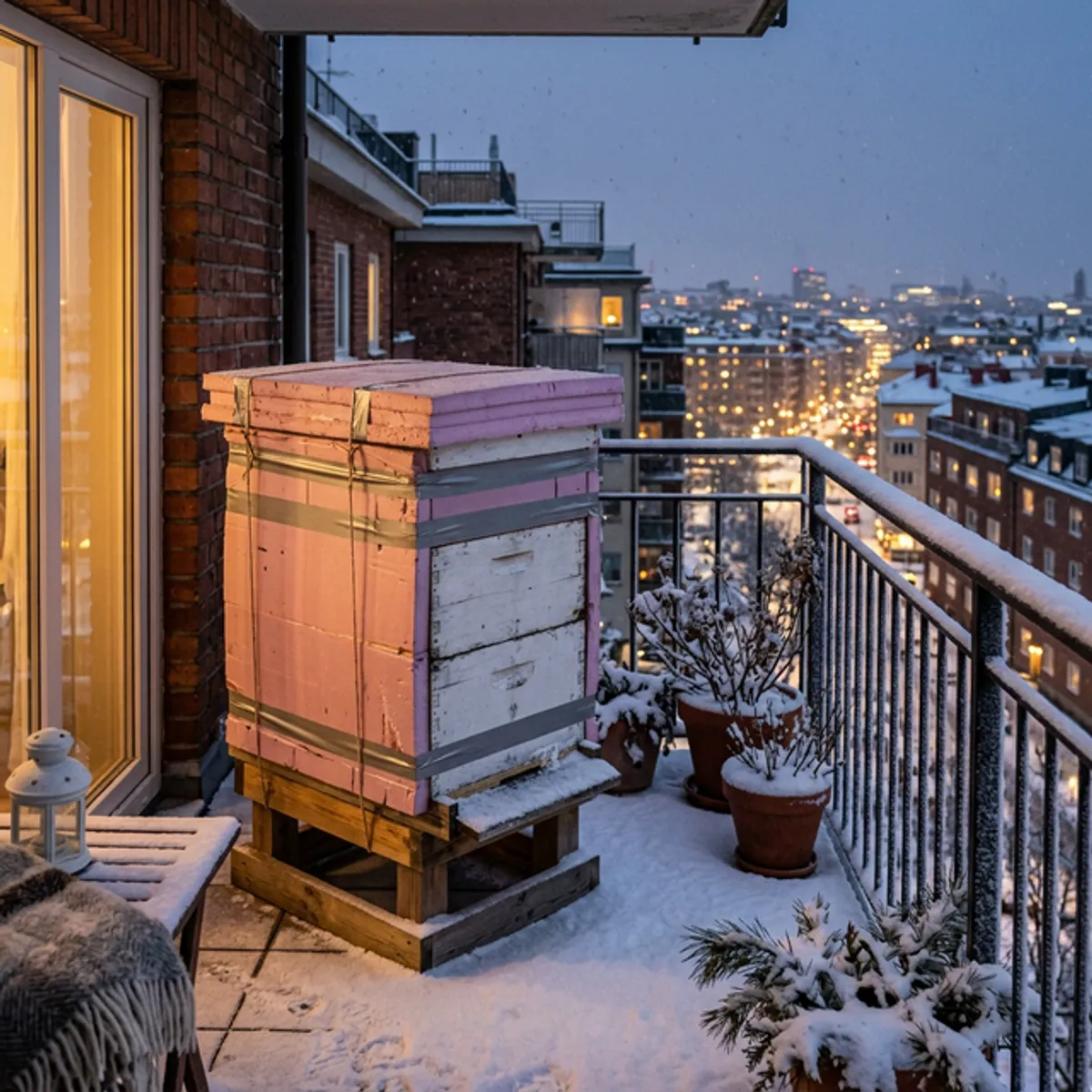
1. Block the Wind, Not the Air High winds strip heat from the wooden box rapidly. Place a sheet of plywood or a rigid foam board insulation panel a few inches away from the hive on the windward side. Put up a barrier, but never plug the bottom or top entrances of the hive itself. They need air.
2. Top Insulation (The Moisture Quilt) You must prevent the moisture from condensing on the ceiling.
- Place a 2-inch sheet of rigid foam insulation (pink or blue board from the hardware store) directly on top of the inner cover, underneath the outer telescopic cover.
- This keeps the wood ceiling “warm” relative to the outside, stopping condensation dead in its tracks. The moisture will instead vent out the front door or through a dedicated top vent hole.
- Read our complete guide on building a Vented Moisture Quilt for Rooftop Hives.
3. Mouse Guards In the city, mice are always looking for a warm place to spend the winter. As soon as the bees cluster up and stop defending the front entrance, a mouse will move right in, eat the honey, and use the wax to build a nest. Install a metal mouse guard over the bottom entrance in mid-October.
Trust the bees. Give them enough honey, control the moisture, block the wind, and they will see you in the spring!