Best Urban Beekeeping Starter Kits for Beginners
Disclosure: UrbanBee is reader-supported. When you buy through links on our site, we may earn an affiliate commission at no extra cost to you. Learn more.
For most beginners with a small city yard, an 8-frame Langstroth starter kit is a sensible place to start comparing equipment: the boxes are narrower than 10-frame equipment, and replacement parts are widely available. Hoover’s current 8-frame starter bundle is the lowest-priced option in this comparison; Dadant’s larger package makes more sense if you want protective clothing and expansion boxes in one order.
Before buying, ask a local mentor which box depths they recommend, try lifting an occupied hive box under supervision, and confirm that your site permits bees. Then price the entire first season—not just the wooden hive. A kit that leaves money for training, bees, and colony care is a better purchase than one that uses up your budget on harvest features.
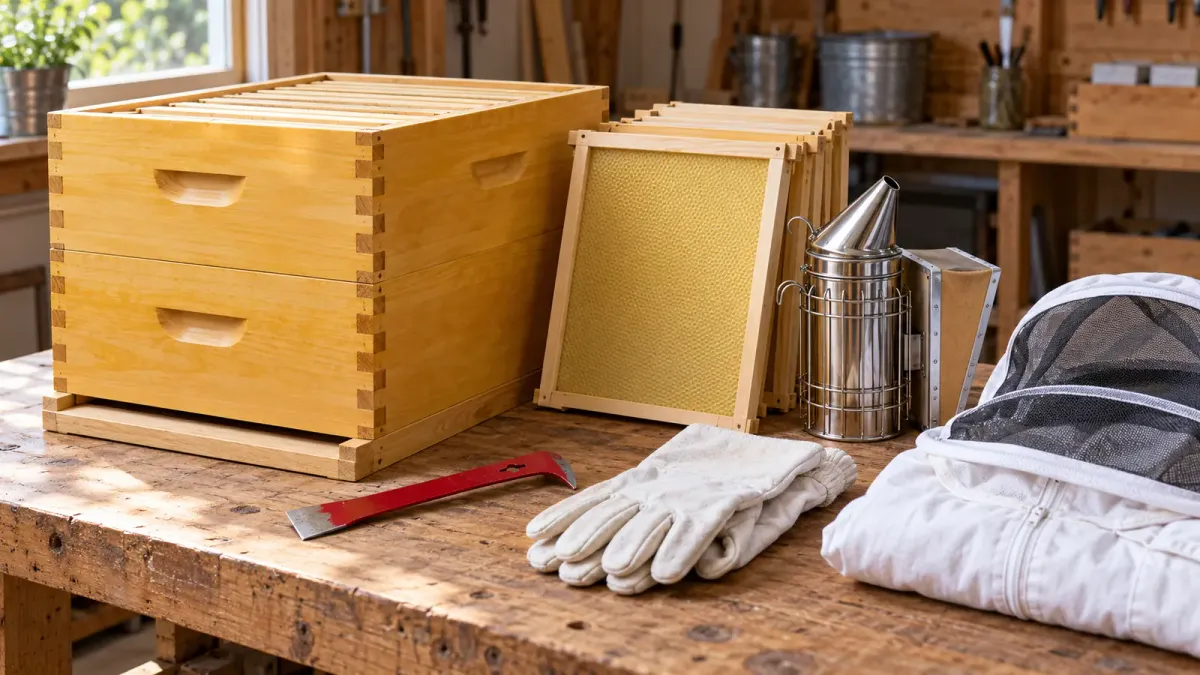
Hero image: AI-generated illustration of generic equipment, not a photograph of any kit reviewed below.
How we compared these starter kits
This is a research-based buying guide, not a hands-on product test. We checked manufacturer listings on October 7, 2026, comparing box format, included tools, protective clothing, expansion needs, and price. The recommendations are editorial judgments about those specifications, not measured durability scores.
We use a “best fit” assessment instead of invented star ratings. Prices below are listed U.S. dollar prices before any applicable tax, delivery charges, or optional upgrades; confirm your selected configuration at checkout. For a broader look at hive designs, see our full review of the best beehives.
Urban beekeeping starter kit comparison
| Kit | Listed price | Frame format | Included equipment highlights | Best fit / main limitation |
|---|---|---|---|---|
| Hoover Hives Starter Kit | $169–$184 | 8-frame box; frame options vary | One deep, covers/base, jacket/veil, gloves, smoker, hive tool | Low entry cost and narrow boxes; expansion equipment and feeder need budgeting |
| Mann Lake Premium Starter Kit | $439.99 | 10-frame | One deep, one medium, smoker, tool, brush, feeder and feed | Traditional equipment with feeding supplies; protective clothing is not listed |
| Dadant 10-Frame Deluxe Beginners Kit | $589.95 displayed base price | 10-frame | Two deeps, one medium, ventilated suit/gloves, smoker, tool, top feeder | More equipment in one order; larger boxes and higher initial cost |
| Flow Hive 2+ | From $899 on the U.S. range page | Six Flow honey frames with 8-frame brood format for the smaller version | Cedar hive, Flow harvesting components; stand optional | Convenient honey collection; budget separately for beekeeper tools and clothing |
Flow’s starting price comes from its U.S. hive comparison page. Six Flow frames are not equivalent to six ordinary brood frames: Flow explains the six-to-eight frame sizing relationship.
Hoover Hives: the first option to price for a small yard
The current starter listing is a single-deep kit, not a two-deep package. It includes assembled, wax-coated wooden equipment and basic beekeeper accessories. That makes it worth pricing if you want to begin with narrower boxes without buying every tool separately.
Check the frame selection carefully. The page describes a three-frame option intended to receive a five-frame nuc, or an eight-frame option for a package, but some option labels on the listing are inconsistent. Ask the seller to confirm the actual frame count before ordering. Also confirm clothing fit and price the feeder and expansion boxes your local management plan requires.
Mann Lake: a feeding-equipped traditional option, not an under-$200 kit
The verified Premium Starter Kit includes a deep brood box, medium super, shielded smoker, hive tool, and internal feeder, plus other accessories. It suits someone who wants assembled 10-frame equipment and prefers to choose protective clothing separately.
At the listed $439.99, it is not a budget-under-$200 recommendation. Do not confuse a bare hive kit with a beekeeper starter bundle: similar-looking listings can exclude the smoker, clothing, or feeder. Compare the exact contents, not the word “complete” in a product name.
Dadant: a fuller package for a ground-level apiary
Dadant’s package combines two deep brood boxes and a medium super with a ventilated suit, gloves, shielded smoker, hive tool, and hive-top feeder. The assembled, painted equipment reduces preparation work; suit, glove, and base selections still need checking.
Our assessment: it is a stronger fit for a ground-level yard with convenient access than a rooftop reached by stairs. More equipment is not automatically better equipment for your body or your site. You also do not need to install every supplied box on a small new colony immediately.
Flow Hive 2+: pay for the harvesting system, not freedom from care
Flow’s premium cedar hive lets you collect honey through its dedicated honey frames and tubes. Consider it if that harvesting method appeals to you and its price leaves enough money for the rest of your setup.
It does not turn beekeeping into a no-lifting hobby. Reaching the brood nest can still require moving equipment. Observation windows do not replace frame inspections, and honey harvesting does not replace swarm or pest management. For a beginner with a tight budget, training and conventional equipment deserve priority over a premium harvesting system.
Should you choose 8-frame or 10-frame equipment?
Eight-frame equipment is narrower and holds fewer frames per box. With otherwise comparable materials and contents, that generally means a lighter box. It does not establish a fixed full-box weight: depth, wood, comb, bees, and stored honey all matter.
Avoid treating “20% fewer frames” as a guaranteed 20% reduction in every lift. A honey-filled eight-frame deep can still be an awkward load. The University of Minnesota’s beginner guidance specifically asks prospective beekeepers to consider heavy lifting and experience a colony before investing.
| Decision | Lean toward 8-frame | Lean toward 10-frame |
|---|---|---|
| Carrying and handling | Narrower boxes are useful when handling is the priority | You have comfortable ground-level access and suitable help |
| Local equipment support | Your supplier and mentor stock this width | Your club primarily uses 10-frame equipment |
| Space | Slightly smaller box footprint helps your layout | Inspection clearance matters more than a few inches of width |
| Compatibility | Keep bases, covers, and boxes matched to 8-frame width | Keep bases, covers, and boxes matched to 10-frame width |
Ordinary Langstroth frames of the same depth can often transfer between these widths; covers and boxes cannot simply be swapped. Confirm the nuc’s frame depth before buying an all-medium setup.
Safety — plan the lift before buying: Never choose a kit on the assumption that you can carry a full hive up a ladder. Arrange a stable working surface, clear access, and help where needed. A balcony or roof also requires confirmation that the structure and access arrangements are suitable; a product’s shipping weight is not the occupied hive’s maximum weight.
Five accessories to check before checkout
A pile of accessories can look reassuring while still missing the item you need on installation day. Check these first:
- Protective clothing that fits. A veil must stay away from your face, and closures need to remain secure when you bend and reach. See choosing the best beginner bee suits before accepting a bundle’s one-size option.
- A smoker with a heat shield. Also plan safe fuel storage and a noncombustible resting place. Our top-rated smokers for city rooftops comparison covers handling features; local fire restrictions still apply.
- A proper hive tool. A standard scraper or J-hook tool can work. Choose a shape you can control while wearing gloves rather than buying several unfamiliar tools at once.
- Gloves with usable dexterity. You need to grip frames securely without crushing bees. Check cuffs and sizing alongside the jacket or suit.
- A compatible feeder. Confirm whether it occupies frame space or needs an extra box. An internal feeder is one option, not a universal requirement; ask your mentor which arrangement fits your climate and inspection routine.
Also budget for mite monitoring, a stable stand, reliable water, and record-keeping. Included feed or supplements are not a substitute for learning when a colony needs feeding or treatment.
Can you keep the equipment budget under $300?
Yes, some bundles fall below $300. Starting and maintaining the colony is a separate bill. Work from an itemized shopping list with three columns: included, buy now, and buy later.
For example, the $184 end of Hoover’s displayed range leaves $116 within a $300 equipment allowance. That remainder must cover any missing immediate essentials; it is not a realistic promise that bees and the entire first season will fit inside it.
Ask your supplier for separate totals for bees, protective gear upgrades, feeder, stand, monitoring supplies, and likely expansion boxes. Add training and delivery before comparing the final numbers. Put an extractor in the “later” column: the University of Minnesota’s startup-cost guidance notes that club rental or another beekeeper’s extraction service may be available.
Avoid unknown used comb as a shortcut. The same university guidance warns about disease and pesticide risks in used hive equipment, particularly comb. A low purchase price can become an expensive colony-health problem.
Do starter kits come with bees?
The equipment listings compared here do not list live bees as included. That does not mean every starter kit everywhere excludes them: a local supplier may offer a separately specified hive-and-bee bundle.
Confirm whether you are ordering a package or nuc, whether a queen is included, the collection or delivery date, and the frames’ size. A nuc brings occupied frames; a package does not. Read buying package bees vs nucs for your new kit before matching bees to the equipment.
Reserve bees on your local supplier’s timetable, not a universal January–February deadline. Penn State’s planning guidance recommends arranging packages or nucs well ahead of spring and planning equipment, location, laws, budget, and Varroa management before purchase.
Legal — check the address before ordering bees: Verify local zoning, hive limits, setbacks, registration requirements, and any lease or HOA restrictions. A seller shipping a hive to your address does not establish permission to keep bees there. Start with our beekeeping laws by ZIP code guide and confirm requirements with the relevant authority.
Before the bees arrive
Unpack early enough to resolve missing parts. Check that frames sit correctly, boxes meet evenly, and covers close; follow the manufacturer’s assembly and exterior-finishing directions.
Set up the stand and water source, try on your protective clothing, and walk through an inspection with your mentor. Leave working room behind or beside the hive and a place to set equipment down. The best beehive for a small yard is one you can actually inspect without blocking a shared path or working against a railing.
Finally, keep the receipt and the exact contents list. When it is time to add a box, knowing your width and frame depth is more useful than remembering that you bought a “beginner kit.”
Frequently asked questions
What is the best beehive starter kit for a small yard?
An 8-frame Langstroth kit is a practical starting point when narrower boxes and manageable handling matter. Choose equipment that fits your lifting ability, local management plan, and mentor’s experience. A small hive footprint does not remove the need for inspection space and safe flight paths.
Can I start beekeeping with a kit under $300?
You can buy some equipment bundles for under $300, but that is not a complete first-year budget. Add bees, missing protective gear, feeding supplies, mite monitoring, a stand, and expansion equipment before deciding what you can afford.
Does a beehive starter kit include bees?
Do not assume it does. The equipment listings compared here do not list live bees as included. Some suppliers sell separate hive-and-bee bundles, so confirm the exact package, queen inclusion, collection date, and delivery arrangements.
Does a Flow Hive eliminate heavy lifting and inspections?
No. Flow frames change how honey is harvested, but the colony still needs brood inspections, swarm management, and pest monitoring. You may still need to lift or move boxes to reach the brood nest.