Auckland Beekeeping Rules: Council Bylaws & Hives
By UrbanBee Editorial TeamSources checked Oct 14, 2026
⚠️ Not Legal Advice: Summaries for educational purposes only. Verify with official Auckland authorities.
Auckland allows managed garden beekeeping subject to its Animal Management Bylaw and bee-management control, national apiary registration and property rules. The current council-linked control requires attention to flight paths, calm colonies, swarming, water and bee excrement. Its bee control focuses on management duties rather than a fixed lot-size hive table.
Check the current bylaw and send council your actual location, land use and proposed hive numbers before installing bees. Complete the national registration process separately; a HiveHub record does not settle council consent or landowner permission.
Auckland council duties versus national duties
| Topic | Auckland council position | National or property check |
|---|---|---|
| Registration | Council bee management is separate from AFB registration | Register with NZBB/HiveHub |
| Fees | No standard garden-beekeeping fee established by the reviewed control | Annual AFB levies and any consent charges may apply |
| Permission | Council permission for hives in public parks; land-use rules also matter | Owner, tenancy or shared-property approval |
| Hive count | No numerical lot-size cap in the reviewed final bee control | Keep a suitable stocking level and check consent conditions |
| Flight paths and setbacks | Reasonable steps to prevent public safety and nuisance risks | Assess adjacent paths, doors and occupied areas |
| Water and colony behavior | On-site water, calm temperament and swarm control duties | Ongoing inspection and disease management |
An absence of a numerical cap is not approval to crowd a site or to operate commercially without checking land use.
The hive-limit table: proposal versus operative rules
In June 2021, council consulted on proposed restrictions for more than two hives on smaller urban properties. A consultation proposal should not be read as an enacted allowance.
The bylaw and control linked from council’s current page include changes commencing December 20, 2021. Control One states management duties, without the proposed lot-size cap.
For a small section, assess whether inspections, water, flight screening and neighbor use can work with the proposed colonies. Ask council about any later amendment or parcel-specific condition. For commercial beekeeping, the published material flags the Auckland Unitary Plan and possible resource consent.
Flight paths and barrier height
The control requires reasonable steps to position and manage hives with minimal impact on others. Its related information suggests a barrier two or more metres tall, placed one to two metres in front of the hive entrance, to encourage higher flight.
That suggestion is guidance supporting the management duty, not a universal statutory 2.5-metre fence rule. If your site assessment calls for a taller screen, our guide to building 2.5-metre flight barriers can help plan the structure; verify any fence-height or building permission first.
Look beyond the boundary line. A route can create a problem at a neighboring door, a shared path, a car park or a play area. Screens need to address the actual route and leave enough access for hive work.
Water, temperament and bee excrement
The bee control requires a suitable water source on the premises and reasonable steps to control swarming and minimize nuisance from bee excrement. It also requires colonies with a calm temperament.
Observe departures on a suitable day and record complaints about low flights or spotting. Discuss a persistent behavior problem with an experienced beekeeper rather than repeatedly inspecting a defensive colony beside a shared area.
If the site is unsuitable, reduce pressure or arrange a lawful alternative location. Do not move a suspect diseased colony merely to solve a nuisance complaint.
National registration now uses NZBB and HiveHub
The phrase New Zealand national AsureQuality apiary registration appears in older instructions, but the current administrator is NZ Bee Health & Biosecurity. AsureQuality no longer manages the Apiary Register.
Use the NZBB registration page and maintain the required apiary identification and AFB inspection pathway. Initial registration is free; annual levies and inspection costs are separate.
Handling complaints and shared sites
Give neighbors or a site manager one reachable contact. Record the time and place of a reported problem, obtain experienced help and save any management changes. If council issues directions or requests information, respond within the stated time.
Hives in a public park require council permission. For a rented garden, apartment terrace or community site, agree on inspections, access, responsibility and removal before installation. A small colony can still make a shared site unsuitable.
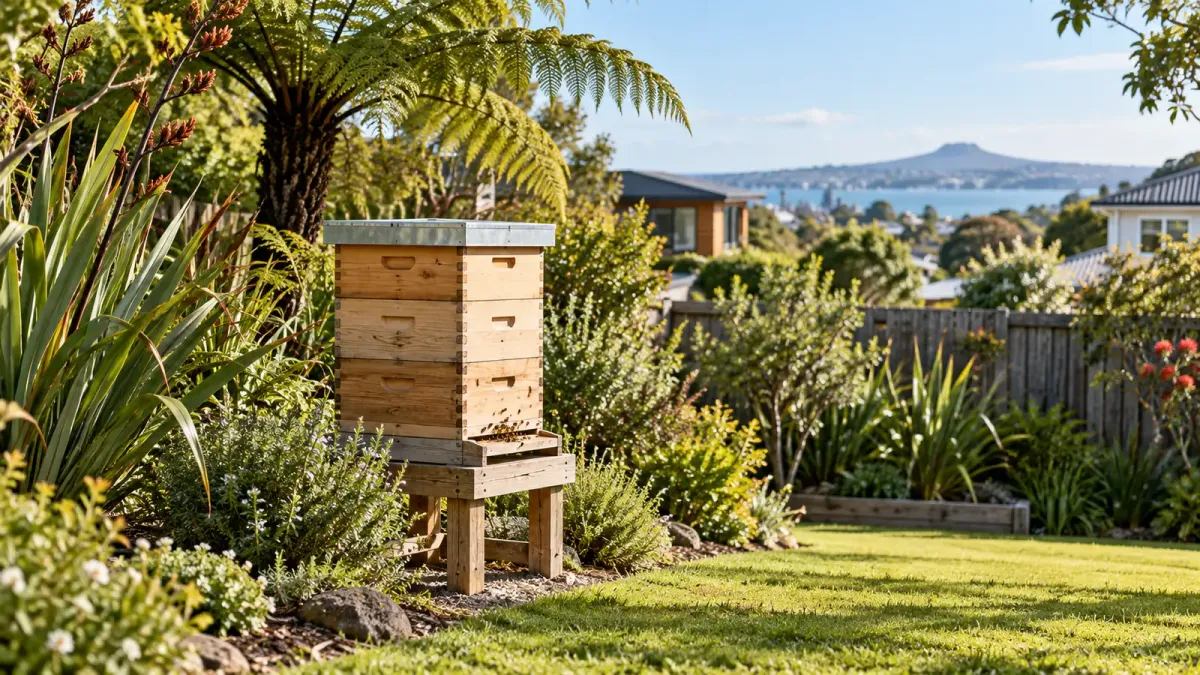
The hero is an AI-generated garden illustration and does not demonstrate a measured section size or council approval.
Frequently asked questions
How many beehives can I keep in Auckland?
The current council-linked bee control does not set a two/four/six/eight-hive lot-size table. Suitability, nuisance duties, land use and any consent conditions still apply; confirm the proposal with council.
Is Auckland’s proposed two-hive limit current law?
A 2021 consultation proposed a limit for smaller urban premises. The council-linked final control reviewed does not include that proposed numerical cap. Use the current bylaw and control rather than a consultation headline.
Does Auckland require a 2.5-metre flyway barrier?
The control requires reasonable steps to manage flight paths and prevent nuisance. Its related guidance suggests a barrier at least two metres tall placed one to two metres in front of the entrance; it does not create a universal 2.5-metre requirement.
Does registering my Auckland apiary with HiveHub replace council permission?
No. National AFB registration is separate from council land-use requirements and permission to use the property. Public-park hives require council permission, and commercial beekeeping may need resource consent.