Wellington Beekeeping Rules: Hive Limits & Council
By UrbanBee Editorial TeamSources checked Oct 14, 2026
⚠️ Not Legal Advice: Summaries for educational purposes only. Verify with official Wellington City, New Zealand authorities.
Wellington City beekeeping rules allow up to four residential beehives without prior written council permission, subject to the adopted Animal Bylaw 2024. More hives require approval, and national registration and bee-health duties still apply.
Check the property’s district-plan classification before choosing a colony count. If the site is council land or the proposal exceeds the residential threshold, obtain permission before installing bees.
Wellington permission routes compared
| Site or proposal | Council requirement | Conditions still relevant |
|---|---|---|
| Residential property, up to 4 hives | No prior written permission under the threshold | Flight paths, water and nuisance management |
| Residential property, more than 4 | Prior written permission | Any approval conditions |
| Rural area as defined by the bylaw | No written permission for keeping bees | Management conditions and national duties |
| Council land | Licence or prior written permission | Land-use and management conditions |
| New park or reserve apiary | Only within a licensed community-garden area | Council approval and site agreement |
The council’s final-document page links the adopted bylaw, effective April 18, 2024. Sections 8 and 12 address the relevant permissions.
Check the zone rather than judging the landscape
The bylaw defines Residential and Rural areas by reference to the District Plan. A large garden, hillside location or rural-looking view does not decide that classification.
Ask the council to confirm the property’s category if unclear. For a shared garden, also establish who can authorize the use and which occupiers need to be involved.
The bylaw includes an explanatory note about pre-existing hive numbers. If claiming that provision for an older apiary, document the history and ask the council how it applies to the present ownership and arrangement. Do not treat it as permission for a new expansion.
Water and flight paths are express conditions
Section 12 requires a suitable water source and positioning that avoids flight paths impinging on neighboring dwellings or living areas. Management must reduce nuisance risk.
Mark doors, terraces, paths and outdoor living space on the site drawing. Allow room to inspect without forcing an assistant into the entrance traffic, and agree on access when the garden is borrowed.
Wellington’s exposed sites also deserve a practical wind and access assessment. Our rooftop beehive guide helps organize elevated-site questions. Any screen or platform may introduce separate property or works requirements.
Council approval can carry ongoing conditions
The council may require relocation or removal where permission conditions are not met or hives cause a nuisance. Being below four does not eliminate those responsibilities.
Keep inspection notes, swarm-management actions and responses to concerns. Arrange a backup keeper when away and review the apiary if nearby outdoor use changes.
Public-land beekeeping requires the responsible authority’s agreement. A garden group can support a proposal, but its informal approval does not replace the council licence or written permission.
Complete national apiary and AFB obligations
Use NZBB’s registration process, normally through HiveHub, and arrange the applicable AFB inspection pathway. The New Zealand guide explains DECA, Certificate of Inspection, annual returns and levies.
Register qualifying sites promptly; the national plan addresses hives kept in one place beyond 30 consecutive days. Display the required identification and retain health records.
Use the international research hub for other councils; Wellington’s four-hive threshold should not be copied into their guides.
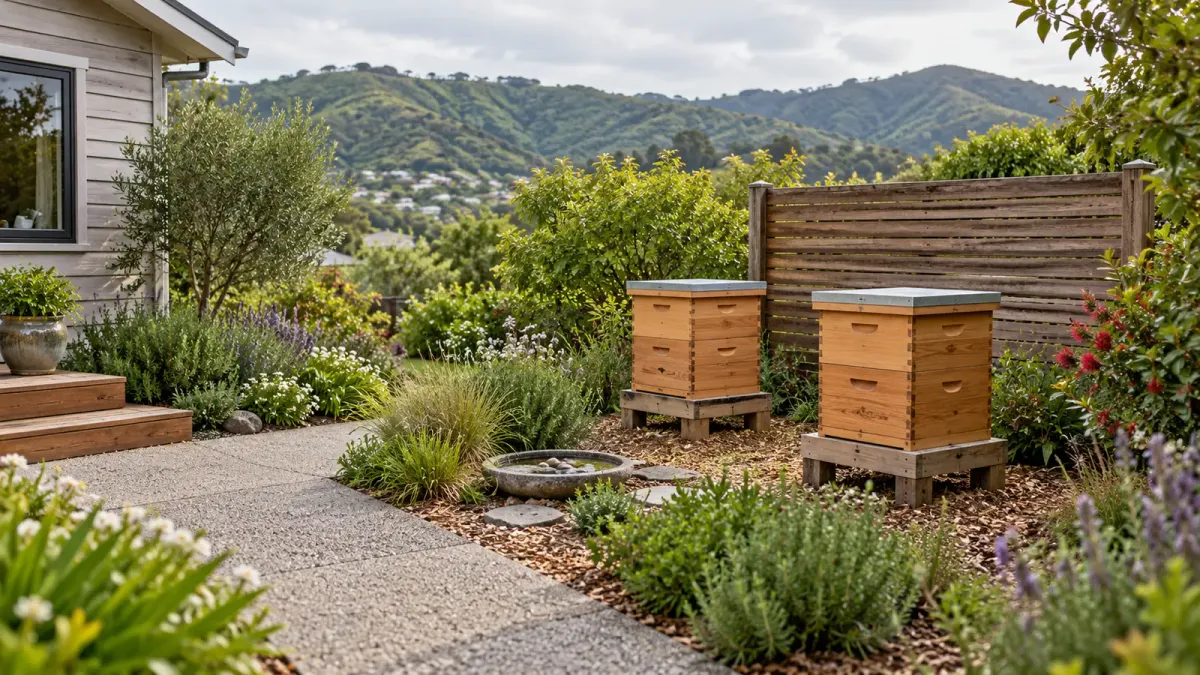
The hero image is an AI-generated illustration; it does not document an approved apiary or measured legal distances.
Frequently asked questions
How many hives can I keep at a Wellington residential property?
Under the adopted Animal Bylaw 2024, up to four beehives can be kept without prior written council permission. More require approval, and nuisance or unmet conditions can still lead to relocation or removal.
Do rural Wellington apiaries need the same prior permission?
The bylaw does not require written permission for keeping bees in its defined Rural area. Confirm the actual district-plan classification; water, flight-path, nuisance and national duties still apply.
Can I place hives in a Wellington park?
Council land requires a licence or prior written permission. The bylaw allows no new hives on parks or reserves land outside a licensed community-garden area.
Do I register my Wellington apiary with the council?
National apiary registration is handled by NZ Bee Health & Biosecurity, normally through HiveHub. Council permission, when required, is a separate process and does not complete national registration.