Miami Beekeeping Rules: Registration & Hive Limits
By UrbanBee Editorial TeamSources checked Sep 5, 2026
⚠️ Not Legal Advice: Summaries for educational purposes only. Verify with official Miami, Florida authorities.
You can keep managed honey bees in Miami if you meet Florida’s registration and siting requirements and have permission to use the property. Start with FDACS, not a generic city hive-limit chart: Florida places regulation of registered, inspected managed colonies at the state level.
Before ordering bees, send your apiary inspector a site plan showing lot size, proposed colonies, boundaries, nearby public activity, access, and water. Check your deed restrictions, HOA or condominium documents, and lease at the same time. A small yard may fit hive boxes without meeting the conditions for keeping bees there.
Legal alert: State preemption is not approval for every backyard, balcony, or roof. Private restrictions and permission to use the property still matter. Get advice on unclear covenants, and check any building work with the authority responsible for your address.
Who Regulates Beekeeping in Miami?
Florida Statute §586.10(1) gives FDACS authority over managed-colony regulation, inspection, and permitting, including placement of registered, inspected colonies. Related county and municipal ordinances are superseded.
That is the starting point for both the City of Miami and Miami-Dade County. It is not a reason to confuse Miami, Miami Beach, another municipality, and unincorporated Miami-Dade when arranging construction or property approvals.
| Question | Start here | What to have ready |
|---|---|---|
| Can this site meet apiary requirements? | FDACS apiary inspector | Address, land classification, survey, and hive plan |
| Can I use a shared yard or roof? | Property owner, association, or landlord | Written permission and relevant governing documents |
| Can I build the proposed fence? | City or county building authority for the address | Survey, fence design, and easement information |
| How can I coordinate mosquito spraying? | Miami-Dade Mosquito Control | Apiary location and reliable contact details |
For example, the City of Miami requires a fence permit for residential and commercial properties. Miami-Dade also publishes fence and gate permitting guidance. Apiary registration does not substitute for those construction checks.
Our overview of Florida state apiary statutes and inspection rules explains the statewide framework.
Registering Your First Hive With FDACS
FDACS requires beekeeper registration, even for one colony. Submit a request through its portal or contact the local apiary inspector; an inspection completes the registration process.
The published annual fee for one through five colonies is $10. Larger operations use higher fee bands. Renewal is due by the certificate’s anniversary date.
Do not confuse annual renewal with a guaranteed annual inspection appointment. FDACS says it inspects apiaries at intervals the agency considers appropriate. Keep the site accessible and follow your inspector’s directions.
Hives must carry the FDACS registration number permanently in the upper-left corner, in characters at least half an inch high. Keep the certificate, inspection correspondence, and equipment records together.
Residential Hive Limits and Placement
For non-agricultural land, use the FDACS Beekeeper Compliance Agreement. Its published density bands are:
| Tract size as described in the form | Standard colony limit |
|---|---|
| One-quarter acre or less | 3 |
| More than one-quarter, less than one-half acre | 6 |
| More than one-half, less than one acre | 10 |
| One to two-and-a-half acres | 15 |
| Two-and-a-half to five acres | 25 |
| Five to ten acres | 50 |
| Ten or more acres | 100; unlimited if all colonies are at least 150 feet from property lines |
Boundary caution: The form omits exactly half an acre and overlaps some larger endpoints. Ask FDACS how it applies to your survey; do not round into a more generous band. Temporary swarm-control allowances and special permits have separate conditions.
The agreement also requires controlled, gated access; continuous onsite water; monthly colony checks; European-stock queen management; and reporting overly aggressive colonies to the assigned inspector. It bars siting within 150 feet of confined animals or frequently used public places and obstructing emergency access. Public-land placement needs special permission.
The 15-foot figure is a barrier trigger
Within 15 feet of a boundary, the agreement calls for a barrier at least six feet high, parallel to the line and extending beyond the colony both ways. Review the design with your inspector, then use our guide to constructing flyway barriers in dense urban yards to plan the layout.
On the site plan, distinguish a property boundary from a public gathering place or animal enclosure. These are different siting questions. Do not assume that adding a tall fence resolves every nearby conflict.
Gentle Stock and Defensive Colonies
Miami beekeepers need a plan for queen replacement before a colony becomes difficult to work. UF/IFAS recommends European queens from reputable sources and explains why leaving queen replacement entirely to the colony can be a concern in Africanized-bee areas.
Ask the seller about queen origin and keep purchase records. “Gentle bees” in an advertisement is not a substitute for monitoring behavior or following the inspector’s instructions. Avoid describing a colony as Africanized based only on appearance.
If routine inspections begin affecting people outside your yard, stop and ask for experienced help. Record what happened, the conditions, and whom you contacted. An entry such as “bees followed workers beyond the gate during inspection” is more useful than simply writing “aggressive.”
Safety alert: Keep bystanders away from a defensive colony and contact your apiary inspector for assessment. During an attack or severe sting reaction, prioritize shelter and emergency help. Miami-Dade’s bee-safety guidance is a useful resource to share with household members.
Hurricane Preparation: Straps Are Only One Part
UF/IFAS hurricane guidance recommends moving colonies away from flood-prone ground and falling limbs, securing hive components, and stabilizing the hives against wind. These are preparedness recommendations - not a verified Miami ordinance specifying concrete anchors or a particular strap.
A strap around the boxes helps hold the hive together. It does not, by itself, anchor the whole setup to the ground. Ask an experienced beekeeper to review the stand and restraint plan; obtain property approval before installing permanent anchors.
Decide in advance:
- Where the colonies could go if this site is likely to flood
- Who can help move them while travel is still safe
- Which loose feeders, covers, and garden items need securing
- How you will check the apiary after the storm without entering unsafe areas
Do not delay evacuation to protect equipment. No backyard tie-down arrangement should be described as hurricane-proof.
Heat and forage need attention between storms
UF/IFAS notes that Florida’s warmth can keep colonies active through periods when northern beekeepers expect a seasonal slowdown. Continued activity means continued food use; palm trees and warm weather do not guarantee adequate forage.
Check food stores and maintain dependable water. Our guide to protecting hives from extreme tropical heat discusses heat management; make any shade arrangement compatible with your wind-safety plan.
Brazilian peppertree can contribute a fall nectar flow, but it is an invasive plant, not a planting recommendation. UF/IFAS discusses alternative forage and notes its typical September–November bloom. Judge the flow by the colonies’ stores, not the calendar alone.
Coordinating With Miami-Dade Mosquito Control
UF/IFAS assigns beekeepers the responsibility to contact local mosquito control, report apiary locations, and request notifications where available. Do not assume FDACS registration automatically subscribes you to alerts.
Start with Miami-Dade Mosquito Control or call 311 for the appropriate contact. Ask:
- How should I submit and update my apiary location?
- What notification options cover this address?
- Which ground or aerial operations may occur nearby?
- Who should I contact if I notice unusual bee mortality?
Keep the response with your apiary records. A notification request is not a guarantee that spraying will be canceled or that every application can be avoided.
Do not wrap hives in plastic as an improvised protective measure. UF/IFAS warns that covering colonies this way can cause overheating. Agree on an appropriate plan with your inspector and the mosquito-control team.
Your own water station should not create a mosquito problem. UF/IFAS recommends emptying, scrubbing, and refilling bee-water containers every five days or sooner. Maintain an available water source while cleaning.
Before Buying Bees: A Miami Checklist
- Confirm the property address, jurisdiction, and agricultural classification.
- Discuss the survey and proposed placement with FDACS.
- Check deed, association, landlord, and shared-property permissions.
- Arrange registration, inspection, and the residential compliance agreement.
- Verify approvals for fencing or other construction.
- Plan water maintenance, inspections, queen replacement, and swarm control.
- Establish mosquito-control contacts and a hurricane plan.
For registration help, FDACS lists 1-888-397-1517 and DPIHelpline@FDACS.gov. Use its current inspector directory to find the person assigned to your location.
Frequently Asked Questions
Can I keep honey bees in a Miami backyard?
Yes, if the site and colonies meet Florida requirements and you have permission to use the property. Start with FDACS registration and the non-agricultural-land compliance agreement, then check private restrictions and permits for associated construction.
Do I need to register just one hive in Miami?
Yes. FDACS requires registration for Florida beekeepers with honey bee colonies, including a single hive. Its published annual fee for one through five colonies is $10.
Is a 15-foot hive setback mandatory in Miami?
The FDACS agreement instead requires a six-foot flyway barrier when a colony is within 15 feet of a property line. Other siting conditions still apply; a barrier does not make every yard suitable.
Does FDACS registration automatically get me mosquito-spray alerts?
Do not assume so. Contact Miami-Dade Mosquito Control, provide your apiary location, and ask what notification arrangements are available. Confirm the process directly rather than relying on registration alone.
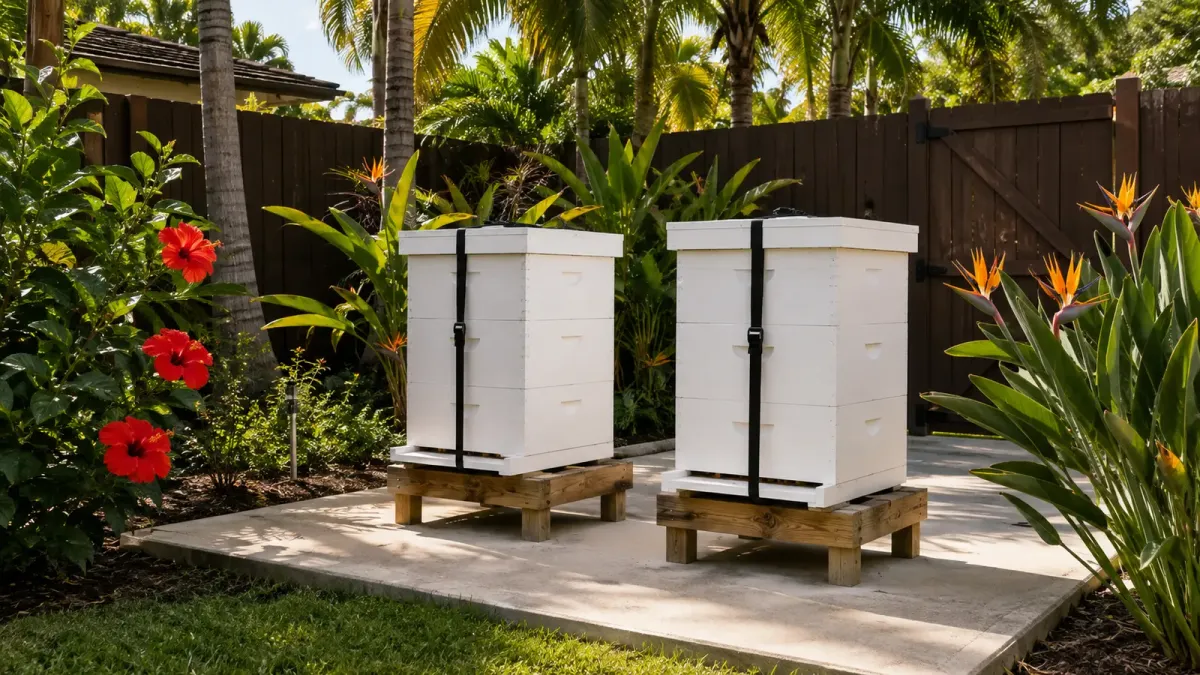
Sources checked September 5, 2026. This is general information, not property-specific legal advice. The AI-generated hero illustrates a backyard apiary; it does not establish regulatory compliance or hurricane resistance.