Alberta Beekeeping Laws: Bee Act, Calgary & Edmonton
By UrbanBee Editorial TeamSources checked Oct 14, 2026
⚠️ Not Legal Advice: Summaries for educational purposes only. Verify with official Alberta authorities.
Alberta requires annual provincial registration for owners of honey bees or used beekeeping equipment, including hobbyists. Calgary and Edmonton also operate local beekeeping licensing systems. A provincial certificate does not approve an urban hive location.
Register with the provincial apiculturist, obtain the required Premises Identification account or number, and check your municipality before buying bees. The current provincial page says registrations expire on June 29, so renew ahead of that date even when local material refers to a June 30 filing deadline.
Alberta registration versus city permission
| Requirement | Alberta province | Calgary | Edmonton residential program |
|---|---|---|---|
| Registration | Annual beekeeper registration; PID duties also apply | Province plus city licence | Province, PID and urban livestock licence |
| Fees | Provincial registration is free | Check current city charges | Check current city charges |
| Permission and training | Local requirements vary | Approved course or accepted evidence of prior beekeeping; site plan | Accepted course, site plan and neighbor notification |
| Hive numbers | No uniform city-yard quota | Usually 2 colonies; additional approval and split allowance | Initially 1 active hive plus a nuc; second-hive application after experience |
| Placement | Check municipal rules | Approved site plan controls | Rear yard; 25 m from public places; boundary/barrier conditions |
Use each city’s current application and guidelines rather than transferring an approved layout from another Alberta municipality.
Alberta Bee Act registration and used equipment
The provincial registration page covers both honey bees and used beekeeper equipment. Renew each year and update major changes through the approved process.
A registration number belongs to the beekeeper; a PID number identifies premises within the provincial traceability system. Do not confuse the two, or assume municipal approval automatically creates either record.
If you stop keeping bees, tell the Bee Health Assurance Team what happened to the colonies and used equipment. Keeping old boxes can retain registration responsibilities even after the live colony has been sold.
Calgary urban beekeeping licences
Calgary’s current program requires a licence for each property where bees are kept. Prepare training evidence, a site plan, the declaration and property-owner consent where applicable.
The usual allowance is two colonies without further approval. A licence holder may temporarily exceed that number for one month when splitting a colony for hive management, according to the city page. Plan the destination of the additional colony before making the split.
Include entrance orientation, fences, structures and neighboring areas on the plan. Ask the licensing team about changes to the approved layout or moving the colony; Calgary requires notification when bees are relocated. Honey selling and other commercial activity need separate review.
Edmonton’s residential rules changed in 2026
The Edmonton beekeeping page says urban livestock licences are required for residential and commercial or multi-unit beekeepers from May 19, 2026. Residential applicants should use the residential process and check any different arrangements for a multi-unit building.
Its guidelines describe one active hive with a maximum of six supers and a nuc for management. Beekeepers with at least two years in good standing may apply for a second hive using a revised plan.
Residential sites must be in the rear yard and at least 25 metres from public places. Hives should be three metres from property lines adjoining neighbors unless separated by a solid fence or hedge at least 1.5 metres high. Confirm the full guideline for your parcel.
The application includes training, PID details and evidence that surrounding neighbors, including those across an alley, were informed. Permission can be revoked when the site or management becomes unsuitable.
Preparing for an Alberta winter
Alberta’s cold climate makes stores, wind exposure and moisture management practical priorities. The provincial beekeeper handbook supports careful seasonal husbandry; it does not create a single province-wide winter-wrap specification.
Use our guidance on insulating hives for severe sub-zero winters to assess exposure and access. Plan fall 2:1 sugar syrup feeding while bees can still process syrup, based on stores and local advice. Do not use liquid feed in conditions where the colony cannot take it safely.
Insulation cannot compensate for untreated disease or inadequate food. Keep entrances accessible without blocking ventilation, inspect records before moving equipment between colonies, and arrange cover if you cannot visit.
Before the bees arrive
Save the provincial registration, PID record, city licence, approved plan and training documents together. Confirm how you will report changes, deal with a swarm and remove an unsuitable colony. A licence is the beginning of the management commitment, not a substitute for it.
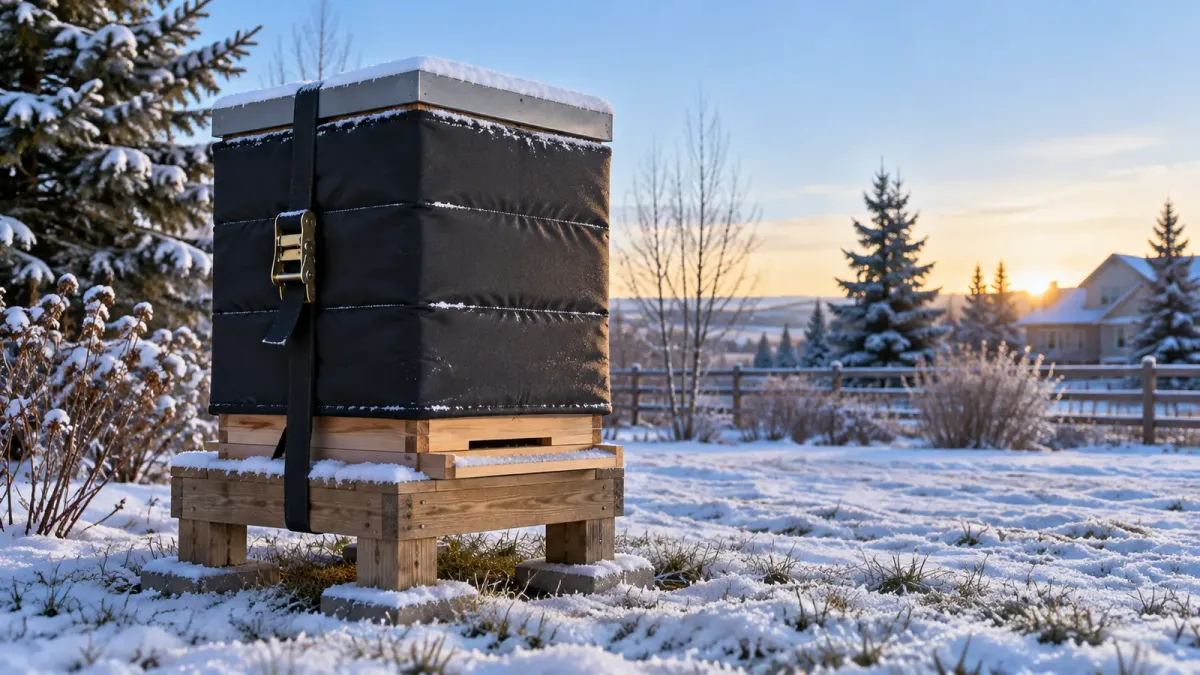
The hero is an AI-generated winter scene; it is not a tested insulation or cold-weather design.
Frequently asked questions
Is Alberta beekeeper registration mandatory for hobbyists?
Yes. Owners of honey bees or used beekeeping equipment must register with the provincial apiculturist each year, including small hobby operations.
When does an Alberta bee registration expire?
The current provincial page says approvals expire on June 29 each year. Renew ahead of that expiry; municipal pages commonly describe a June 30 annual filing deadline.
How many colonies can I keep in Calgary?
The standard city licence allows up to two colonies without further approval. Calgary provides a one-month allowance for additional colonies when splitting for hive management.
What are Edmonton’s main residential hive conditions?
Edmonton requires an urban livestock licence. Its guidelines start with one active hive and a nuc, rear-yard siting, separation from public places, and boundary or barrier conditions. Experienced keepers can apply for a second hive.