Choosing a Hive Style for the City
Disclosure: UrbanBee is reader-supported. When you buy through links on our site, we may earn an affiliate commission at no extra cost to you. Learn more.
Disclosure: UrbanBee is reader-supported. When you buy through links on our site, we may earn an affiliate commission at no extra cost to you. Learn more.
Urban beekeeping comes with unique constraints: limited space, close neighbors, and often the need to haul equipment up to rooftops or balconies. Choosing the right hive style is crucial for success in a city environment. This guide compares three popular hive types – Langstroth, Top Bar, and Flow Hive – focusing on their pros and cons for small spaces. We’ll look at which hive has the smallest footprint, discuss aesthetics (which hive looks best on a balcony), and end with a recommendation. (Spoiler: an 8-frame Langstroth hive often hits the sweet spot for urban beekeepers concerned about weight and space.) Along the way, we’ll cite scientific insights on hive thermal efficiency, where relevant, to ground our advice in research.
Comparison Table: Pros and Cons
| Hive Type | Pros | Cons |
|---|---|---|
| Langstroth | - High honey yield - Modular and expandable - Standardized frames - Easy to find parts and support | - Heavy lifting required - Invasive inspections - Risk of crushing bees - Needs vertical space |
| Top Bar | - No heavy lifting - Natural comb building - Easier for bee inspections - Good wax yield | - Large horizontal footprint - Fragile comb - Non-standard parts - Lower honey yield |
| Flow Hive | - Minimal disruption at harvest - Visually attractive - No extractor needed - Uses Langstroth base | - Expensive - Plastic components - Requires standard inspections - No beeswax recovery |
Space Requirements: Which Hive Has the Smallest Footprint?
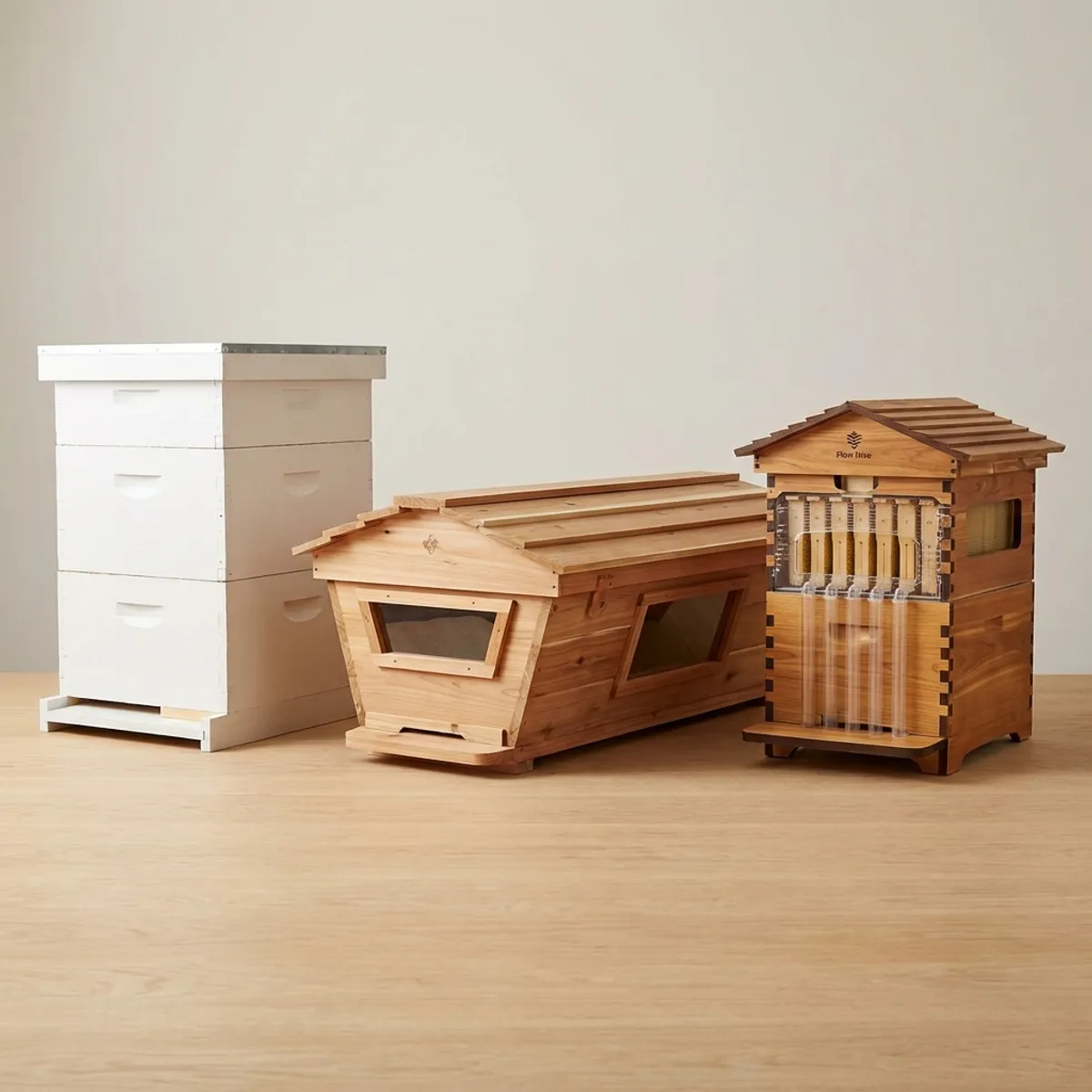
- Langstroth (8-frame): ~14 x 20 inches (0.18 m²). Most space-efficient. Vertical growth means limited floor usage.
- Top Bar Hive: ~4 ft x 2 ft (0.74 m²). Horizontal and bulky. Harder to fit on narrow balconies.
- Flow Hive: Same as Langstroth (either 8 or 10-frame footprint). Needs a bit of rear clearance for honey harvesting jars.
Winner: 8-frame Langstroth for smallest footprint and easiest fit in tight spaces.
Research from Honey Bee Suite notes TBHs are often too bulky for small balconies and are awkward to move. Flow Hive confirms that even urban balconies can fit their hives due to Langstroth-compatible dimensions. Vegas Bees reports that 8-frame Langstroths are more manageable in size and weight for rooftop use.
Aesthetics: Which Hive Looks Best on a Balcony?
- Langstroth: Boxy but customizable with paint and decorations.
- Top Bar: Rustic, natural, and unique design. May resemble garden furniture.
- Flow Hive: Sleek cedar finish, viewing windows, and modern appeal.
Winner: Flow Hive, if budget allows. Otherwise, a painted Langstroth is a solid contender.
According to the Flow team, their hives are designed to be visually pleasing and suitable for balconies. Sunset Magazine praised the TBH for blending well into gardens. Langstroths are often used in urban apiaries with decorative customizations.
Thermal Efficiency: What Science Says
Thermal efficiency is important for bees, especially in urban microclimates with wind or shade. Smaller hive volumes help colonies conserve heat in cold seasons.
- A 2022 study (El-Din et al.) found that smaller, insulated hives had higher brood production and better winter survival.
- 2024 research by Kutby et al. showed Warré hives (similar in volume to 8-frame Langstroth) maintained more stable temperatures than larger Langstroths.
- Vegas Bees notes that 8-frame hives are narrower and help the bee cluster stay thermally efficient during cold seasons.
- Some TBH users recommend partitioning unused space with follower boards to help bees conserve heat.
Takeaway: Smaller hive cavities (like 8-frame Langstroth) are easier for bees to keep warm and efficient.
Recommendation: Why 8-Frame Langstroth Is Best
The 8-frame Langstroth hive is the best choice for most small-space beekeepers due to:
1. Weight Reduction
- Full 10-frame deep box: up to 90 lbs.
- Full 8-frame deep box: ~60-70 lbs.
- Easier to manage and carry through narrow or high spaces.
Hilary Kearney notes 8-frame boxes are more manageable for women, seniors, and rooftop beekeepers. Many beekeepers use medium boxes for even lighter lifting.
2. Footprint & Expandability
- Most compact design with stacking capability.
- Easy to add boxes vertically without using more floor space.
- Compatible with nucleus colonies, standard equipment, and accessories.
3. Thermal and Structural Efficiency
- Smaller internal space helps bees conserve heat in winter.
- Better brood survival and honey storage observed in compact hives.
- Top entrance placement on a balcony helps manage bee flight paths.
4. Support & Compatibility
- Standard design used globally.
- Equipment, mentorship, and replacement parts readily available.
- Compatible with Flow frames for future upgrade options.
Bottom Line: If you’re beekeeping on a balcony, rooftop, or small yard, the 8-frame Langstroth hive provides the best balance of space, weight, thermal performance, and availability.