Ireland Beekeeping Laws: DAFM Registration & Dublin
By UrbanBee Editorial TeamSources checked Oct 14, 2026
⚠️ Not Legal Advice: Summaries for educational purposes only. Verify with official Ireland authorities.
You may be able to keep honey bees in an Irish garden, provided property permission, local requirements, bee-health duties and nuisance risks are addressed. DAFM’s published registration service concerns primary honey producers as Food Business Operators. Ask DAFM which registration and bee-health duties apply to your intended activities.
Contact the Department of Agriculture, Food and the Marine (DAFM) about your intended honey production and bee sourcing, then confirm the site’s requirements with the correct local council. If the proposal is in Dublin, establish which Dublin-area council and property manager govern the address.
Ireland beekeeping requirements compared
| Topic | National requirement or published guidance | Site-specific question |
|---|---|---|
| Registration | DAFM primary honey-producer/Food Business Operator process | Which category and activities apply? |
| Fees | Confirm current registration or service charges with DAFM | Separate site, insurance or permission costs |
| Permits and movement | Bee import/export and animal-health rules apply to relevant movements | Are proposed structures or uses approved? |
| Maximum hives | No uniform nationwide garden allowance verified | What can the site support without nuisance? |
| Boundary distance | No single nationwide setback verified | Check local conditions, flight paths and neighbors |
| Honey sales | Food hygiene, traceability and labelling requirements | Is packing or retail activity included in the plan? |
This guide covers the Republic of Ireland. Northern Ireland has a separate administration and bee-health system.
DAFM registration: use the honey-producer process
The DAFM registration service states that primary producers such as honey producers must be registered as Food Business Operators. The beekeeping and honey page lists primary producers, association apiaries and honey packers or purchasers.
Request the appropriate form through the current contact shown there. Explain whether the honey is solely for personal use, sold, supplied to others, packed for another beekeeper or produced at an association apiary. Ask DAFM to identify the requirements for that activity.
Do not assume an online livestock portal registers every bee keeper, or that registration authorizes a garden location. Keep the registration confirmation and the guidance for the actual operation.
Garden beekeeping and neighbor relations
Place hives where the entrance route does not cut through a shared path, regularly occupied garden or doorway. Supply water before the bees arrive, retain access for inspections and plan how a swarm or defensive colony would be handled.
Our guide to residential garden beekeeping laws offers an address-check workflow. Its U.S. examples are not Irish legal limits; use it to frame questions for the Irish authority and property owner.
A tenancy, management-company rule, community-garden agreement or other property condition can restrict the proposed site. Discuss uncertainty before buying equipment and save written consent. A beekeeping course, mentoring and suitable liability cover help make the practical plan workable; check current association insurance terms rather than assuming a fixed nationwide cover requirement.
Dublin city, suburbs and rooftops
Dublin City, South Dublin, Fingal and Dún Laoghaire–Rathdown are separate council areas. Use the actual address to find the right planning and property contacts. Dublin City’s current biodiversity-plan consultation concerns nature-conservation strategy; site permission for a honey bee apiary needs a separate check.
For a roof or terrace, obtain owner or management approval and appropriate assessment of loading, access, wind, fire procedures and safe edges. Confirm who can enter for inspection and how colonies would be removed if permission ends.
For a shared garden, show where visitors and maintenance staff move. State colony numbers, water provision and the beekeeper’s responsibility during absences. Avoid promising that a screen will prevent every sting or complaint.
Bee health, sourcing and the native Irish black bee
DAFM’s bee-health information provides routes for disease advice and import/export enquiries. Check requirements before ordering overseas queens or bringing bees into the country; a supplier’s assurance does not replace the applicable health documents.
Native Irish black-bee conservation focuses on Apis mellifera mellifera and local breeding goals. Ask the relevant association, such as FIBKA, and the site or breeding-group operator about sourcing expectations before introducing a queen.
The Oireachtas bill page records the status of proposed native honey bee protections. Distinguish a bill, voluntary conservation agreement and enacted law rather than assuming all conservation areas carry the same statutory ban.
Honey sales and damp-winter planning
FSAI’s honey guidance covers product requirements. Its notice explains new honey-origin labelling rules effective June 14, 2026. Check the current rules before printing labels, especially for blended or purchased honey.
For hive care, plan managing winter dampness and moisture boards around local conditions. Good drainage, inspection access and sufficient stores are husbandry decisions; there is no single moisture-board specification established here as Irish law.
Complete the activity-specific registration and property review before installation, and keep the source, health and honey records together.
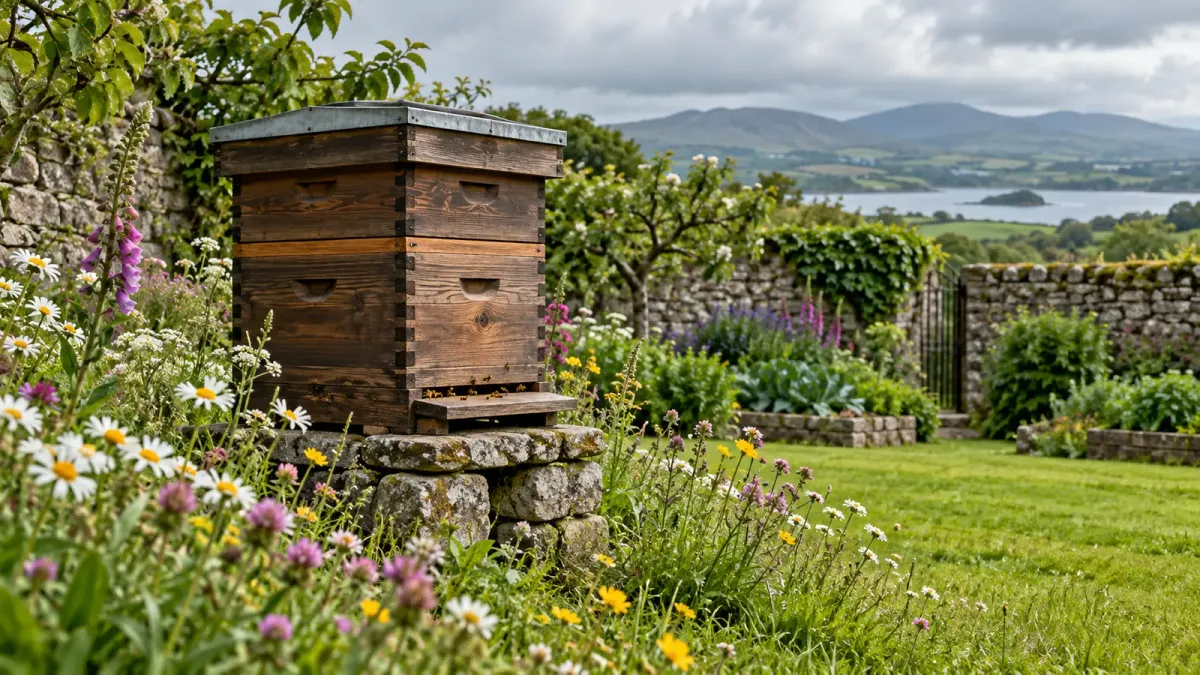
The hero is an AI-generated Irish garden illustration, not a registered or approved apiary.
Frequently asked questions
Can you keep bees in your garden in Ireland?
A garden apiary may be possible where property permission, local land-use requirements and nuisance risks are addressed. Check the actual address and the duties that apply to your honey-production or bee-movement activity.
What does DAFM registration cover?
DAFM’s published service registers primary honey producers as Food Business Operators. Its beekeeping page also covers association apiaries and honey packers or purchasers. Ask DAFM which category and requirements apply to your operation.
Is there one Dublin hive limit or setback?
No single limit or distance applying to all Dublin-area addresses was verified in the sources reviewed. Identify the correct council and check the property, land use and proposed site.
Is native Irish black-bee conservation automatically a legal ban on other bees?
Do not assume that. Conservation agreements, breeding-area conditions and enacted import or animal-health law are different. Check the current legislative status of any proposed ban and the rules for the source and destination.